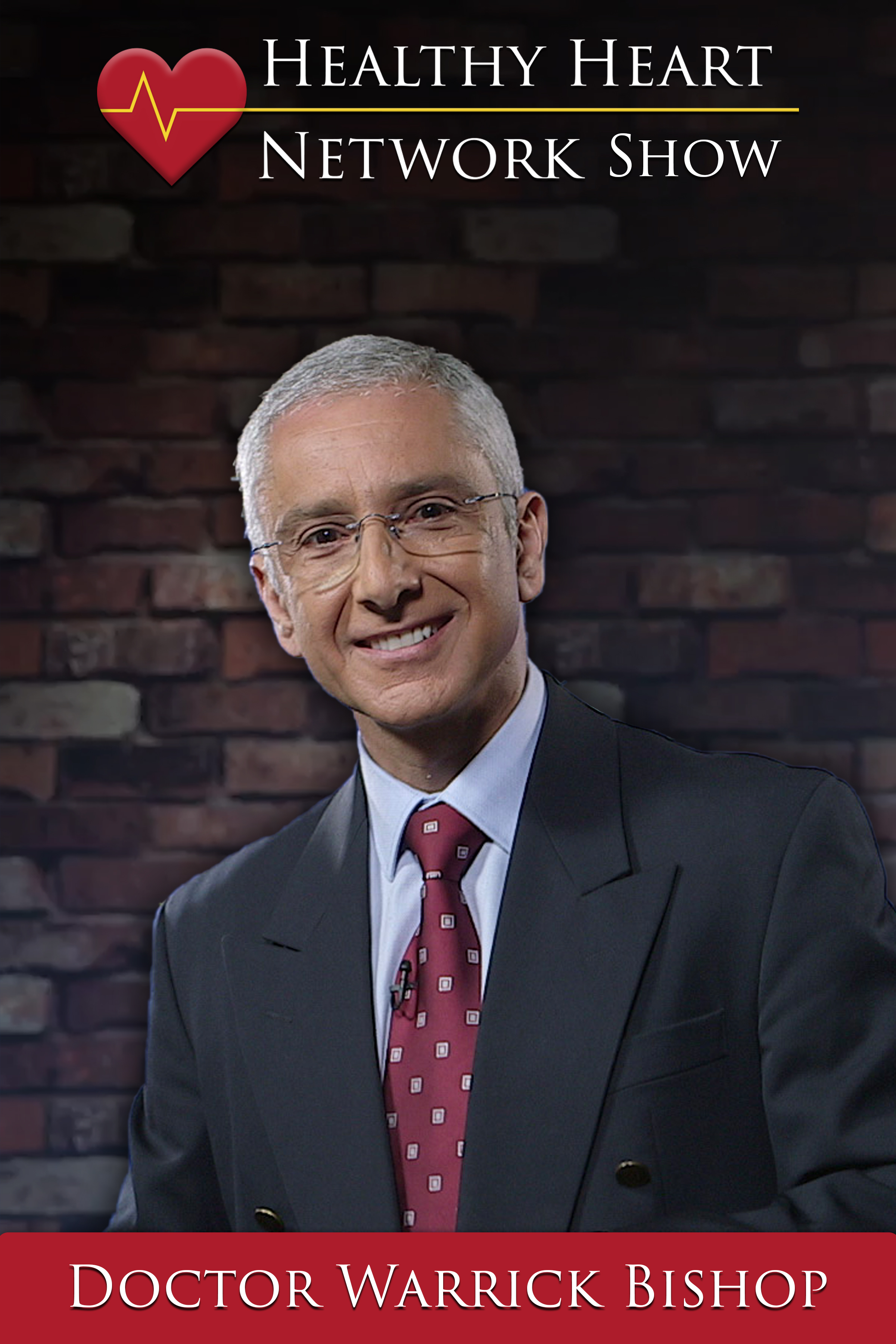
I believe we can prevent heart attack. We can put in place strategies to reduce risk. We can literally plan to change your future. Welcome. My name is Dr. Warrick Bishop. I'm a cardiologist. I'm an author and a keynote speaker. Together with that, I'm CEO of the Healthy Heart Network and I'm all about trying to help people live as well as possible for as long as possible. You probably know, heart disease is huge in Australia. Every 20 minutes someone suffers a heart attack and we know that over 20 people per day die from heart disease. This is on a backdrop of over 9 million people globally being impacted by this condition. Truthfully, most of these could probably have been avoided if only we knew what to do. This podcast is all about helping you understand better where blood pressure, weight, cholesterol and all the other bits and pieces around there can help together with general health literacy for general better health. I am on a mission to impact not just heart health but general health on a global scale. If you enjoy this podcast, I would be honoured for a five-star review and... You can share it with your family and friends. Who knows? It may well save someone you love. Hi, my name's Dr. Warrick Bishop and welcome to my podcast and videocast station. I really do appreciate you taking the time to listen. Today I'd like to talk about some of the newer directions that we're seeing when it comes to managing valves. Well, valves are pretty important. You've only got four, so you've got to look after them. My own practice in recent time has been to look at getting an echocardiogram on new patients if they've never had one before. An echocardiogram is the ultrasound that we do on the heart. Think of the scan that gets done on women who are pregnant to look at the baby. That uses ultrasound and that gives us beautiful pictures. For the heart, the images allow us to see the heart. actually working, pumping, squeezing. We can do all sorts of measurements but really importantly we can look at how the valves are working. Well why do I get an echocardiogram on patients when I see them for the first time if they've not had an echocardiogram before? Well mainly because we know that we turn up a number of problems with valves. About 1% of people have an aortic valve that has two leaflets rather than three leaflets. That's called a bicuspid aortic valve. That's fairly important because it can wear out and require replacement. It can also be associated with the aorta dilating. We might talk a little bit more about that presently. We also find that some people develop... Leakage of their mitral valve, leakage of their tricuspid valve and narrowing of their aortic valve in spite of them having three leaflets or a normal looking valve. All this is really important. Historically we've tended to track abnormal valves and track patient symptoms and look at parameters of severity judging when to do our procedures. Because cardiac thoracic surgery is a big deal, we've generally waited and waited to make sure that the risk of the surgery is clearly outweighed by the benefit of the surgery for an individual patient. If you think that through, at one extreme, if someone's got a near normal valve with some very, very, very early changes, you wouldn't leap in and... do surgery because the risk of the surgery is clearly far greater than the problem that person has with their valve. At the other extreme, if the valve is barely working at all and the heart is decompensated and the patient can't do anything and equally is decompensated, then trying to do surgery then is going to be an enormous risk. And because the heart is decompensated, the heart may not improve. Well, between those two extremes is just right. And the Goldilocks spot seems to be moving. Well, what do I mean by that? Historically, we've used terms to describe aortic stenosis as mild, moderate and severe. And very severe. We've tended to wait. until the aortic stenosis is severe to very severe before we operate, often because these patients surprisingly don't have much in the way of symptoms. It turns out, however, that when we look at large bodies of data related to aortic stenosis, that the outcomes for patients who have moderate and moderate to severe aortic stenosis are really quite poor. And we're wondering, through our observations, if leaving the heart, the left ventricle, under load with a tight valve for a prolonged period of time means that these people suffer the consequence of left ventricular deconditioning from lack of an early intervention, which leads to a poor outcome. The upshot of this is that we are pivoting gradually towards recognising that perhaps we should be treating aortic stenosis earlier. This is a dynamic space. But if you've not ever had an echo, I suggest you go and get one, just to check. And if you do have aortic stenosis, please don't miss your follow-ups with your cardiologist, because this is a changing landscape. a opportunity for a different strategy. So do keep your appointments. Well that's the aortic valve. The mitral valve I'm not going to touch on because we've now seen that we can use clips to clips that can be put in place from the groin so a transcutaneous through the leg approach and this is pretty interesting but what's become very interesting is that we now have transcutaneous or through the leg approaches for the tricuspid valve and I think this is going to be a very interesting area and one that is certainly going to grow. Why is that? The tricuspid valve historically has been considered a less severe valve. And one that we really don't operate on until late because operating for a single right heart problem is generally considered high risk. It turns out if the right heart deconditions, the body is deconditioned as well because the build-up of blood congestion leads to liver damage and general deconditioning of that individual. We have... on the horizon what look to be very promising techniques for repair of the tricuspid valve before it gets to severe while it's still moderate maintaining the integrity and function of the valve to enough of a degree that the body doesn't decompensate. This is a real problem but it looks like we've got a real opportunity on the horizon and again an opportunity to be acting sooner rather than later. The other area where we're probably going to be doing things sooner rather than later is in regard to dilatation or expansion of the aorta which is the big blood vessel that comes out of the heart. That aorta is pretty important and we normally see it coming out At about 35 odd millimetres in diameter. Now, I mentioned bicuspid aortic valves before. They're associated with a dilatation of the aorta. So is a condition called Marfan's. And there's a couple of other conditions of the connective tissue. Where people seem to be, if you like, more stretchy than average. Marfan's is one. Ehlers-Danlos is another. Where the aorta... does in fact dilate, and that can be a problem. So if we're thinking about an aorta that should be 35mm in diameter, historically when that aorta has got to 50 or 55mm, and this is pretty substantial, and therefore at risk of rupturing and killing that person pretty well immediately, We then look to operate and that operation requires bypass surgery where the person goes on a bypass machine while a piece of the aorta, the affected piece of aorta is cut out and a piece of Dacron graft is put in place. Well the operation is pretty good of course but it does mean that the patient needs to go on bypass and it does mean that the patient ends up with a piece of aorta that is not actually theirs. a graft. It's foreign material. Well, one of the sessions I went to offers an alternate solution to that approach. And the session I went to was about a procedure called the PEARS procedure. Let me spell that out for you. PEARS stands for Personalized External Aortic Root Support. And for this particular procedure, instead of putting someone on bypass and instead of cutting out their aorta, they are opened up and a Dacron mesh is wrapped around their aorta to hold it in place and even reduce its diameter a little. Now, why is that important? Well, it turns out that this is, if you like, preventative surgery. And we don't often think of surgery. as preventative. But this is. Historically we've waited until people's aortas are 50, 55 millimetres and this is pretty scary. I told you we start off with an aorta that's about 35 millimetres. But this technology... probably is appropriate for starting to be considered for individuals who have aortas of about 45mm, which means during the time that they grow, potentially from 45 to 50, 55mm, by putting one of these pairs procedures in place, we may reduce risk of aneurysm disruption for that individual. A very interesting space where we may see, if you like, pre-emptive or earlier surgery because the technology looks like it averts bigger issues down the line. Well there you go a little bit about valves and the aorta and where it seems to be going. I got all that from the recent Cardiac Society meeting in the Gold Coast in August 22 and it is always. exciting as anything to go along and find out what's on the horizon and what will be available for my patients in the future well I hope you found that interesting I really do appreciate it if you've listened this long if you've enjoyed the podcast please share it around and if you get the chance to review it I'd love you to do that unless you don't like it in which case keep that to yourself for now I am going to wish you the very best till next time live as well as possible for as long as possible. Take care and bye for now. Join the Healthy Heart Network and become part of our growing community. Do you want to know more about your heart health and know more about your risk of heart attack? For $5 get lifetime access valued at over $55. The Healthy Heart Network has been designed to support and help you understand. your risk of heart attack, your risk level where you are right now, and the positive steps you can take to reduce that risk. Check it out at www.healthyheartnetwork.com and press the join the family button.