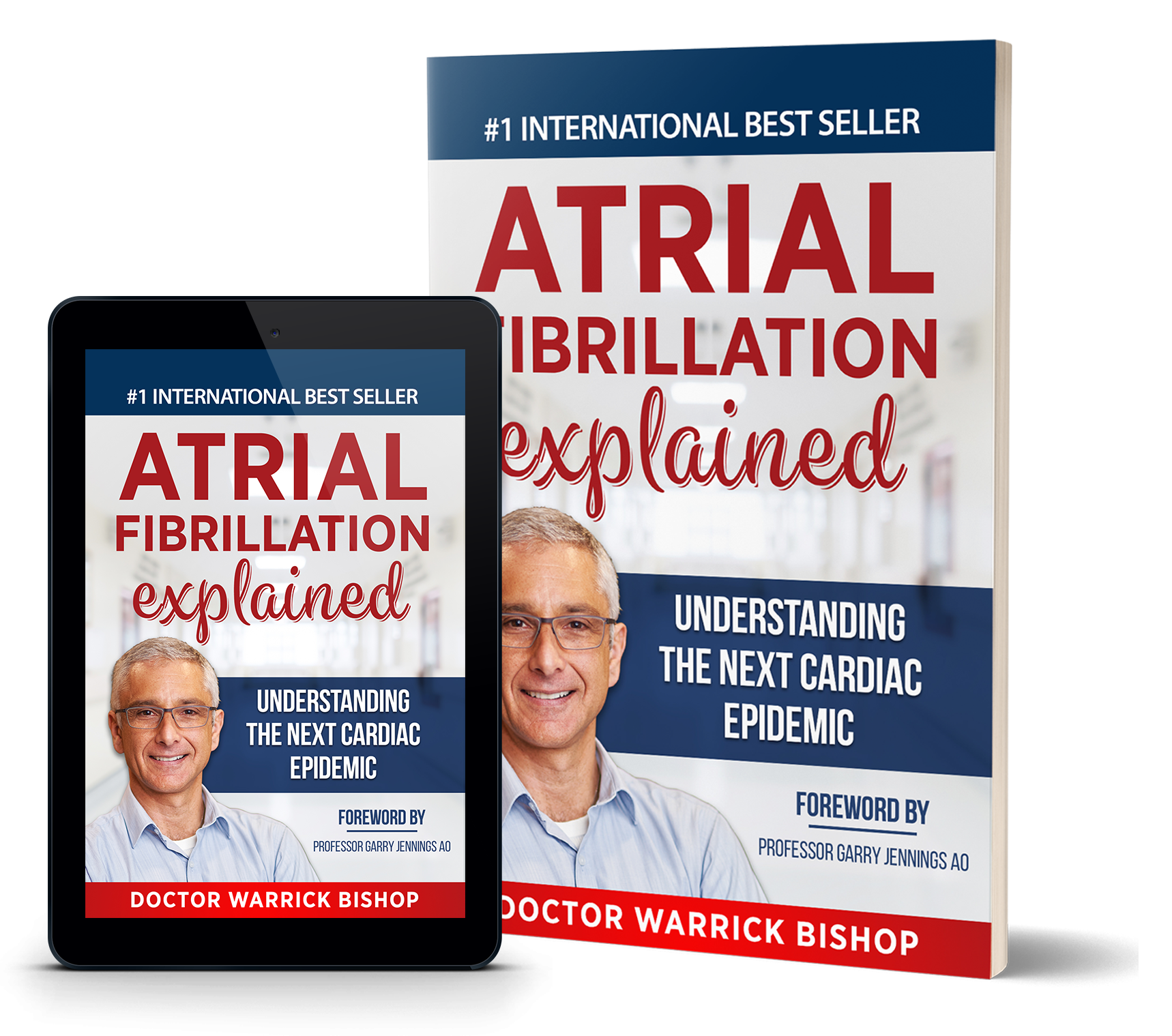
Welcome to Dr. Warrick's podcast channel. Warrick is a practicing cardiologist and author with a passion for improving care by helping patients understand their heart health through education. Warrick believes educated patients get the best health care. Discover and understand the latest approaches and technology in heart care and how this might apply to you or someone you love. Hi, my name is Dr. Warrick Bishop and welcome to my podcast and videocastation. Today I'm delighted to have the opportunity to interview Tanya Hall, who is CEO of Hearts for Hearts. And we're going to find out more about Tanya and more about Hearts for Hearts today. Tanya, welcome and thank you for joining us. Hi, Warrick. Thanks for having me. So this is in the middle of the COVID-19 crisis and I'm just going to let everyone know we're social distancing. I'm down here in Hobart. And Tanya, where are you at the moment? I'm in Melbourne, Victoria. So we're, well, we're about a thousand kilometres away from each other. That we are. So no risks there. Look, I'm really delighted to have you. to share some stuff about yourself and Hearts for Heart today. But first of all, for people who may never have heard of the organisation, could you tell us what Hearts for Heart is all about? Yes, certainly. So Hearts for Heart is a national charity. We support, educate and advocate for Australians living with heart disease. And we're also New Zealand too. And we specialise in arrhythmias, heart arrhythmias. So we facilitate national heart buddy groups and we facilitate national, you might have heard about AF Awareness Week. So we run national screening events for atrial population and arisnias. And we do a lot of advocacy work in federal government. So we work with federal government on ensuring that, or work towards ensuring that patients have access to therapy. So just in terms of someone who might be listening to this and not really sure what advocacy for people with heart rhythm disturbance mean, can you put that in really simple terms for just maybe an example of the sort of thing that has come across your desk in the last couple of months to just make it a bit easier to understand? Yeah, sure. So I guess particularly with the COVID-19 situation, cardiologists are working hard to look after their patients from home and so at the moment and particularly for those patients that have pacemakers and defibrillators there's what's called remote monitoring and so we have been working with cardiologists to try and get cardiac monitoring funded. And so that's something that we've been advocating for with the Cardiac Society to try and get that funding so that cardiologists can monitor patients from home. So that's an example of one of the things that we advocate for. Another thing is that a treatment for atrial fibrillation and arrhythmias, as you well know, Warrick, is catheter ablation. And so we've been working very hard. over the past few years to have that funded and available in hospitals. So things like that is something that we would advocate for so patients have access and not have to wait. Fantastic. Have you got, is that a background noise at your end or mine? Very quiet here. Okay, it's probably me. Look, so for people who are not medically minded, pacemakers are the devices that sit in your chest and keep the heart beating if you don't have your own rhythm. So Tanya's talking about monitoring those remotely without having to go into the clinic. And similarly, devices that sit in that sort of just under the shoulder area, which can restart the heart if, for example, the heart rhythm goes out. These are defibrillators and that's the same. concept where Tanya's advocating or trying to advance the opportunity for people with these devices to be able to be checked from home, which is just a fantastic idea in the normal world. But in this COVID-19 world where we're trying to isolate and trying to reduce risk of contact, it's a great idea. The other thing that Tanya was touching on was catheter ablation. And what that means to the layperson is wires and tubes that go into your heart by by very highly qualified cardiologists in a specific area of rhythm with the heart to alter or ablate or destroy or control funny rhythms that that individual could have. So Tanya, just your own story a little bit. You're CEO of Hearts for Heart. How did that come about and where does your interest lay in this area? Yeah, sure. So I'm a heart patient myself and I was... born with heart problems and it's a very long story but I was in my early 30s and I was having a number of heart problems and was in and out of hospital for a period of three years and looked for information and support and there wasn't anything available and so You know, the more people I ask, the more I realise that there are a lot of people out there that also needed information and support. And so I thought I'd start something myself. And so initially I thought I'd start a website and provide information that I had found along the way. And long story short, we grew really quickly. And so I guess over the years we have grown. We grew quite quickly and we were providing, you know, facilitating support groups nationally within a year and then started running awareness campaigns. And then a cardiologist started knocking on our doors saying that there were access problems in terms of, you know, therapy problems. And so we've sort of grown organically and gone into different areas. And so that's how. that's how i suppose we've um how we've grown so yeah so it's through my own experience that that house by heart was founded so how many people would be in the organization or um within your membership tenure just approximately we have it's difficult to say but we would have a few thousand people and people follow us at different times and um i mean we screw him and even with the screening events that we run we screen thousands of people each year and we pick up undiagnosed atrial fibrillation each year and we hear many stories that we've prevented strokes, which is an incredible feeling for us. I mean, that's what it's all about. You know, so, and obviously, I mean, there's lots of different levels of support that we provide. We provide over-the-phone support too. We bring people together in person for peer support and now we're providing as we facilitate the zoom meeting heart buddy groups now obviously because we're unable to meet in person so there's a support aspect there's the um public awareness that and prevention that we that we sort of facilitate and then there's the advocacy side so we're sort of trying to tackle it from all areas but but yeah so it's it's difficult for us to um to put a finger on how many people that follow us because, again, there's the public side and then there's the patient support side, but there's most definitely thousands of people. So when you think about particularly, let's step away from advocacy and awareness from home because you talked about Atrial Fibrillation Week and you've talked about the advocacy for remote monitoring. Let's talk about patient support a little. Just a couple of examples, perhaps, of individuals that you can think of off the top of your head where Hearts for Heart has really been able to reach out and help these people when they've needed something. Could you share an example or two, Tanya? Of people that have needed our support? Yes. I mean, we have a range of different patients that come to us, you know. I mean, atrial fibrillation is a condition. I mean, you've joined our... heart buddy group recently via Zoom, which was wonderful. Thank you. And you provided. And we do have different people that join our Zoom meetings and even heart buddy groups to, you know, if people have questions or, you know, we have different experts in different areas that join us. But atrial population is one area that we obviously that we run campaigns on because it's the most common arrhythmia. But we do have other people with different conditions. So we have ventricular tachycardia and we have congenital heart disease patients and we have various different heart conditions because there are so many. You know, we don't have just the patients who have coronary heart disease. Sorry, that's my dog barking in the background. And so we often link patients with similar conditions. Sorry, I might just grab her because she might continue to bark with me for one second. Sorry about that. This is a problem with working from home during COVID-19. So we often link patients. together uh so that they can share their story and so that they don't feel alone so that's something i just really think it's important to point out because do you at times have patient education material that you shoot out absolutely so we have developed a good point we have developed different um education materials and the education materials that we have developed we go through a number of different processes so we have um patients together um we bring patients together and we facilitate focus groups so we make sure that we are addressing a number of different patients needs and then we have our medical advisory committee that come together um and so that that they collectively write them together and then we have the patient focus group review them again so we go through a number of steps to make sure that we are writing them in a way that patients like to read them and interpret them and understand them. Have you come across any excellent books lately about atrial fibrillation that could inform patients about this complex condition? Sorry, what was that? Have you come across any excellent books lately about atrial fibrillation that could inform patients about this complex condition? I have. actually. There's a cardiologist by the name of Dr. Warrick Bishop that's written a wonderful book on atrial fibrillation. Shameless plug. But we're going to come toward an end now. It's been fantastic to talk. If people wanted to know more about Hearts for Heart, presumably they go to the website. Yes. Absolutely. I imagine you'll be... sharing this on your social media when the time comes and you'll include a link below. I'm actually, apart from trying to put a shameless plug about my book in there, I am actually proud to be working with Hearts for Hearts so that we're able to make my book available to members within Hearts for Heart or on behalf of Hearts for Heart. And we're able to... put some money back into the organisation to keep it going so that individuals can get some great information and we're able to help parts for heart along the way. It is terrific to hear you've got not just support but awareness and advocacy all covered and it sounds like it'll just keep growing because these these problems really increasing in numbers, we do raise awareness and become more and more tuned in to the importance of dealing with these issues properly. I'm going to wrap up, Tanya. Is there anything you'd like to finish up with or any last thoughts? No, I would just say that if you have any queries or questions, please do visit our website, which is www.heartsforheart.org.au or visit our Facebook page, which obviously Warrick will also provide the links at the bottom of this podcast. But thank you for having me, Warrick. It's a pleasure being here. Tanya, thank you so much for joining me. For those who have tuned in, I really appreciate your time and I hope you've enjoyed today's interview. If you have any queries or questions, as always, drop us a note on members at drWarrickbishop.online. If you've got any suggestions for future podcasts, of course, let us know. And with a bit of luck, we'll have the chance to speak with Tanya Hall again. Take care. Bye for now. Until next time, good health. Hi, my name is Dr. Warrick Bishop and welcome to my podcast and videocast station. I'm absolutely delighted today to have the opportunity to speak with Tanya Hall, who's CEO of Hearts for Heart. But more than that, she's a human being and a patient who suffers with arrhythmic disturbance. And today, I'd really like to take the opportunity to talk about the broad spectrum of rhythm disorder and how variable it can be between different people. But before we do, Welcome, Tanya. Thank you for joining us. Hi, Warrick. Thanks for having me. So just a brief introduction and then Tanya can add to this, but Tanya's CEO of Hearts for Heart. She's been running that organisation for a decade or thereabouts and became involved with Hearts for Hearts, which is a support and awareness and advocacy group for rhythm disturbance for... individuals with rhythm disturbance, and she's also suffered rhythm disturbance herself. So just if you're comfortable, Tanya, give us a little bit of your own medical history background and a bit of a picture of where things started for you and bring us to where we are now. Certainly. So I was born with a hole in my heart. It was when I was in hospital with wheezing bronchitis that my cardiologist or that the doctors picked it up when I was six months old. And I was monitored for nine years. I had quarterly appointments with my cardiologist and it wasn't until I moved to Sydney that I had my first check-up when I was nine years old that they decided to then operate. And I had open heart surgery and I was okay post-surgery up until I was probably about 17, 18. And that's when I had my first arrhythmia. And so... I pause you there just for a second, Tanya. For those who are listening who don't understand what a hole in the heart is, it's a pretty scary sounding thing having a hole in your heart. This is a really important organ that you don't want holes in. Well... So from us talking about this previously, if I could just share, Tanya, your particular situation was a hole in the heart. There was a connection between the two top chambers of the heart or what we call the atria, the pre-pumping chambers. So these top chambers of the heart give the blood a little squeeze so that the blood goes into the main pumping chambers. On the right-hand side, the main pumping chamber pumps out to the lungs. On the left-hand side, the main. pumping chamber pumps out through the aorta to the body and gives rise to the pulse that we feel. So the atria are the pre-pumping chambers or the slightly smaller chambers at the top of the heart. And it was a connection or a defect in the wall that should separate those two. That was your trouble. Had that fixed at nine years of age. And then it wasn't until 18, you had some problems with arrhythmia. How did that come? Yeah, so I woke up feeling like I was having a heart attack and my, you know, my chest was moving and it was going at 200 beats a minute and I sort of crawled to the bathroom and I started vomiting and I called a taxi, which is crazy, went to the doctors and they sort of made me do these, you know, breathing exercises to make it stop, which is crazy. I wish they did an ECG because then it took... sort of years for them to actually put an ECG on me to get the you know to find out what it was um because as you know that's what you need to do to get to diagnose it um and uh anyway and because that's what happened it then started it just got progressively worse as time went on and um and so um and I guess I've had, you know, to cut a long story short, because that has been a long journey between now, then and now I've had, I've got, I have a pacemaker and I have, mine is rather complex because I suppose there's quite a lot of scar tissue on my heart from that procedure, that open heart surgery. I've been told that part of it is because of the procedure and part of it is congenital, part of it is because I was born with it. So I have atrial fibrillation, but I also have a few other arrhythmia conditions. So I've had a couple of catheter ablations and obviously I have the pacemaker. And the catheter ablations that I had 10 years ago did help me for quite some time. for 10 years actually and I recently had another catheter ablation which solved one problem but I now have another. So I'm waiting to have another procedure. So I'm still not able to walk without having arrhythmias or even... I could jump in there for a moment. Tanya, just for anyone who's listening who doesn't know what a catheter ablation is, because it's a little bit science fiction sounding, really. What's a catheter ablation? Well, it's where doctors who are trained in the electrics of the heart introduce wires, what we call catheters, but wires basically, up into the heart. Often from an access point in the leg, in the groin, we pass tubes up and we move those catheters or wires around inside the heart. And they often have a freezing or a burning tip on the end. And those freezing and burning tips allows to damage tissue that could be part of a short circuit in the heart. And so by damaging those tissues or removing those short circuits, we can bring some stability to the rhythm. So you had one. It sounds like you had a catheter ablation 10 years ago or thereabouts. You've had another one recently and you're waiting for another now. So it sounds like complex times. So when this rhythm comes, how much does it impact on you, Tanya? Are you able to go to work and can you play sport? Does it stop you having a glass of alcohol? Tell us how it impacts your life. Yeah, look, for me personally, I'm not able to do sports because for me, again, if I even go for a short walk, it does come on. Even at the moment, if I stand, it tends to come on. But again, it affects everybody differently. Some people are able to exercise. and and and and don't feel it and and their clinician has given them the okay that it's completely safe for them to be able to exercise so don't and as of course you're the cardiologist so so you'd be the best person to talk to about that but but for me it impacts me so i'm unable to do it because i'm out of breath and i i can't breathe properly so um So I'm unable to do it. And I don't drink alcohol because it affects me. So it impacts my life in that way, I suppose. So I think one of the things that I'd really like to highlight in this opportunity to speak with you is the huge diversity of presentation that we see with this condition of atrial fibrillation. You describe or represent someone who's had significant symptoms at a young age, clearly with quite a lot of impact on your life. But I can tell you from my consulting room, I see individuals who come in who are elderly and the condition is found by chance because they're having an ECG because they're going to get a new knee or a new hip and they'll swear blind that they have no symptoms. And I can tell you that they continue to enjoy a glass of wine or beer or whiskey on a regular basis. So it's a remarkable condition that seems so different in different individuals. And I guess you see that through the organisation too. Absolutely. Absolutely. And that's why it's so important to have the discussion with, again, with your cardiologist to seek that advice as to what is safe and what is not, you know. you know and I yeah and again for me it's just that it just it feels it feels unsafe for me to do so and I know it impacts me and again you know I think it's um it's just simply because my body doesn't like it you know it just and and as you said some people just doesn't you know people just don't feel the symptoms and sometimes that's a good thing and sometimes it's a bad thing because for those with atrial fibrillation that don't feel the symptoms it can be quite dangerous because you know they don't have access to or they they don't know perhaps that that treatment is really important for them that they you know that they might not be put on a anticoagulant or that they you know have exactly right so one of the if i could speak to that for a moment one of the real concerns about atrial fibrillation is if that top chamber of the heart is not pumping properly and blood pools in that chamber and collects, that blood can form a clot. And if that blood forms a clot, then eventually breaks off and goes to the brain, it can cause a devastating stroke. And so the tragedy, and this is why you've got Awareness Week, so I know that, and the tragedy of atrial fibrillation that people are not aware of is that the first time that it could become apparent is when an otherwise well person ends up in hospital with a stroke. Right. So very, very serious. That's an end of the spectrum when it comes to symptoms that you just don't want to go near, actually. Exactly. So, no, it's a remarkable situation. And just only because those numbers are pretty close at hand to me, we know that atrial fibrillation affects about 1% of the entire population. So that's a lot of people in 20 million of our country. We also know that it affects people more as they age. So, Tanya? If I can pay you a compliment, you seem like an outlier because 10 years young and fit and well and doesn't look like the standard atrial fibrillation patient. That's because of the stress her heart was under from issues with congenital heart abnormality. But the most common patients with atrial fibrillation are older with multiple comorbidities. And we know that nearly 15% of the population have atrial fibrillation if they're over 80 years of age. So check your pulse if you're over 80 years of age. Get someone to check it for you. Make sure it's okay. Tanya, you're looking pretty well at the moment. On a day-to-day basis, does the atrial fibrillation impact you? Is it something that's front of mind or is it something that really when it comes, it gives you the most strife or how do you deal with it on a day-to-day basis? Yeah, look, the arrhythmias, you know, absolutely affect me on a day-to-day basis. But at the moment, obviously, I'm in a situation where I'm working from home with COVID-19. So, you know, I mean, I try and get some fresh air. So I try to go for a little walk, even if, you know, even when I'm having the irregular heartbeat, because it's still important to try and get a little bit of exercise in. But, you know, again... I think we're all impacted by COVID-19 no matter what. So even though, you know, the procedures have all been postponed, you know, we're all, again, we're all impacted, aren't we? So I think I'm in a position where, you know, I'm able to work from home. So I'm safe here. I know that if I need to go to hospital, that it's safe for me to go to hospital because it's still really important that we're all keeping up with our cardiology appointments and that we're going to hospital if we need to. So I'm, you know, I'm fine. But it is impacting me every day. But again, it's just the situation that we're in. And I think, you know, we just have to take it day by day. Look, we've been talking for... over 10 minutes and the time absolutely flies. So I really appreciate that. But we're going to wrap up just for trying to keep to a reasonable timeframe. Before I do though, you've, Live this yourself. You give people support. If there's someone listening who's had atrial fibrillation for the first time or second time, I imagine they would have fear and apprehension and uncertainty about what it all means. Have you got some words from your own experience, some reassurance or guidance or something you would say to someone who's really confronted this condition, this rhythm disturbance for the first or second time and they're new to it? Look, I would just say that, you know, I think the most important thing is following your cardiologist advice. You know, as long as you're taking the treatment that your cardiologist is giving you, then you're really, it's not as scary as what it seems to be. You know, I think that's what's most important. You know, you can live a normal. a normal life I think it's just most important that you're following the guidance you know it's um I I you know my my my situation is really complex and so mine's probably um I am a little bit different than most so mine does sound probably a little bit scarier than than most but a lot of people can live with atrial fibrillation and not even feel it you know so um so again I think Listening to your cardiologist and being educated about it can take the anxiety away. It really can. So I think just listen to what they say, take the treatment that they recommend, and you're already off to a really good start. Yeah, great advice. What I'm going to do is I'm going to say look up Hearts for Heart because they do provide support and they've got information. They are a great organisation and reach out to them as well because they need support from you so that they can support you back. I'm going to wrap it up there. It's been an absolute delight talking with you, Tanya. For those who are listening, thank you so much for joining us. If you have any queries or questions, drop us a line at members at Dr Warrick. Bishop.online. If you've got any suggestions for future podcasts, let us know. As always, thank you so much for your attention. Until next time, I wish you the very best and please don't die from a heart attack. Goodbye. You have been listening to another podcast from Dr. Warrick. Visit his website at drWarrickbishop.com for the latest news on heart disease. If you love this podcast, feel free to leave us a review.