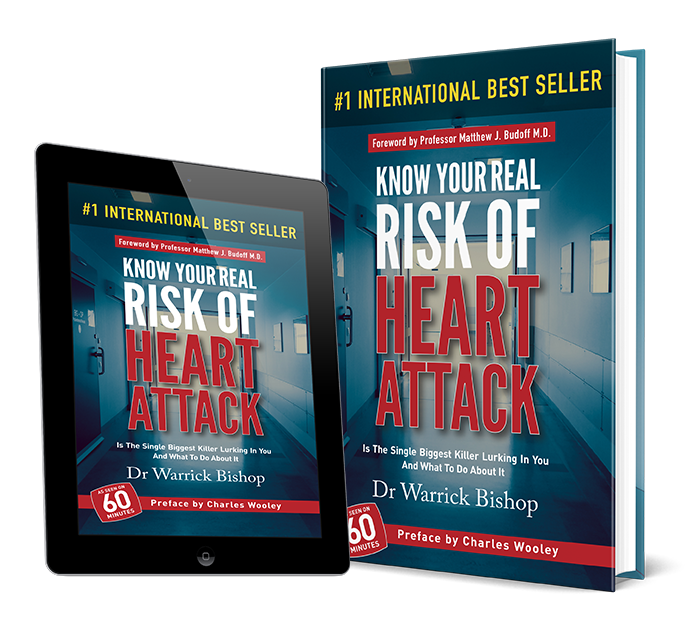
Welcome to Dr. Warrick's podcast channel. Warrick is a practicing cardiologist and author with a passion for improving care by helping patients understand their heart health through education. Warrick believes educated patients get the best health care. Discover and understand the latest approaches and technology in heart care and how this might apply to you or someone you love. Okay, we're going to cut this one short because we've already lost six minutes of our time. And I really want to introduce Dr. Warrick Bishop. He's in the studio with us today. As I said to you before, it's a cardiologist, very interesting to talk to. He wrote a book. I'm not here to promote the book, obviously, and he's not here to try to sell you the book. We are just here to make sure, to give you an understanding of what could arise when you have heart problems. So I think at Plus, I passed the... The microphone there to Warrick. So Warrick, why did you write a book in the first place? It's a book which you've written which is called Have You Planned Your Heart Attack? So I came to see you and you recommended. So I came to see you I think about two or three years ago and you recommended for me to take some statins. I decided to come back, let's say, two or three years later and you suggested for me to take this can. So tell me a little bit about it. Why did I have to do that? And then I can tell you what my response was based on the book that you have written. Look, first of all, Renato, thank you so much for having me. this afternoon and for the opportunity to share with your audience and talk about what i think is an incredible opportunity which is not to wait until someone's had a problem with their heart but try and find issues before they have a problem and literally put in place strategies to prevent them having a heart attack so thank you for the chance to share with you and your audience today i really appreciate it look i wrote the book very much out of a sense of desire to get a message out there i Realise that there's an opportunity to scan the heart and really look at the health of someone's arteries, which is a far more precise way of evaluating exactly what's going on. You'll know for yourself. You've met people or know of people who've been apparently fit and well, and they... surprisingly unknowingly drop dead from a heart attack and everyone shrugs their shoulders and says well how's that with the reality to a large degree is that the health of your arteries isn't always reflected by what you look like on the outside and I really want to get that message to people I have spoken to quite a few people since I read a book and people were telling me about it oh you know it's too technical and medical terminologies. Well, in actual fact, it is not. Like I said, I read the whole book, I took notes, and I find some parts of the book are quite comical, and they are very easy to understand for the normal person. A normal person like me, I'm not a doctor, I wouldn't have any ideas about terminologies. When I decided to purchase this book, which is, I'll tell you one thing, it's worth every single cent of it, I thought myself, well, I'm going to read it. The more you read, and the more interesting it became. Look, in many ways, you represent exactly what... the objective of me writing that book was and that was to educate and inform people because there's no question the best educated patients get the best health care they understand what's going on they understand why the doctor's got a particular strategy in place and of course because of that they work with the doctor and everyone gets the best outcome from that Now, in trying to write the book, it's my absolute passion, so I'm really excited about it, but that's no good if all I'm using is long words that... The average person, the person on the street who hasn't got that same set of medical terms, that's no good for them. So I worked really hard with my co-author and we really, really made an effort not only to try and take complex issues and bring them into simple language, but also to make the book enjoyable with stories and cartoons and little jokes as well, just to keep it alive, to highlight points where we thought it was relevant. I thought we were going to play another song and then we carry on. with the conversation because it's quite a very interesting conversation, okay? Yes, it is. Okay, let's listen to Pavone. Because we are talking about heart, well, what we're going to do, we have programmed this hour based on the heart, right? But all in songs. Okay, let's listen to Rita Pavone intitolato Il Cuore. Sentiamo. Benissimo, Rita Pavone con il titolo Cuore. Continuiamo ancora con il dottor Warrick Bishop, come vi ho detto, è un cardiologo studiato qui in Tasmania, in Australia. So, dottor Warrick, let's resume. have a conversation a little bit about when you go and see a GP, they'll analyze you with your arm. A blood test, and the first thing they said to you, they give you a medication. I mean, not everyone wants to take a medication, okay? Therefore, I've noticed in here that you suggest that it's not just an analysis of the patient and a blood test, but it's a little bit more involved to conclusion or to an advice. So can you tell us a little bit about what's the best way to do it? So there's a couple of things you covered there. First of all, you're asking why is my book not broadly available at the moment? And to a degree, that's partly because the uptake within the medical community is limited by what we call guidelines, which are the informed documents that really are a summary of the data that's available and the studies that have been done in a particular area. It turns out that imaging the heart is relatively new. So if you think about it, it's... really quite advanced and not necessarily have all the studies been done that demonstrate exactly where it fits in our practice. So that means that there are no guidelines supporting where it fits. If you think about the timeline beyond that, once a guideline's published, then a GP... or a general family doctor has to have time to read that guideline so there's a big gap between what may be available at the coalface right now and how long it'll take for that to be implemented by the bulk of doctors and that's It's the same for everything. And it just so happens that this imaging, because it's moved very quickly, fits in that space. So I've really tried to get this message out to the community because at the moment it's not changing from the top down. It's not changing by studies, guidelines and doctors picking it up. And what I've wanted to do is short circuit that and get the information out to individuals who are motivated, who want to know more, who want to be educated so that they can have the conversations they need to have with their local doctor. to find if this is appropriate for them. So I want to ask you, what is really a heart attack? I mean, people say, oh, you know, I've got symptoms, so I might get a heart attack. But what is it? I mean, what's a heart attack? So a heart attack is a very layman term. And really, if we were talking about it as a couple of non-medical people on the street and said, we have a friend who's had a heart attack, really what we're saying is that we know someone's had something bad happen to their heart. And that's all it means. In our terminology, in medical speak, we don't use the word heart attack. We talk about lack of blood flow to the heart. It damages the heart muscle. We call that an infarction. If lack of blood flow to the heart causes pain, we call that angina. So we talk about damage to the heart muscle or lack of blood flow to the heart muscle. We don't tend to use the word heart attack, which is a general sort of colloquialism. Talking about this heart attack, I mean, if I'm fit, I do my training every day, would I be prone or have a heart attack in the middle of the street? So this is a really, really important concept to get your head around. There's absolutely no question keeping fit and exercising and eating the right things and genuinely... Generally, looking after yourself is a really, really important thing to do. But in spite of that, we know of or we even personally know people who have done that and still had a heart attack. And that's partly because the process is more complicated than just related to how fit you are or just related to whether you're carrying extra weight or not. There are many, many links in the chain that can end up with plaque. or buildup of cholesterol in the arteries, leading to a blockage. You're talking about plaque here. I mean, what's a plaque? What does it do? Where does it sit? So, great question. When we talk about plaque in the arteries, what we're talking about is localized areas or patches of buildup of cholesterol in the arteries, where cholesterol's moved into the wall of the artery and started to build up. We call that a plaque, and those plaques can build up. and they can close off that artery. That's what we want to know about. Okay, the next thing I want to ask you is, okay, let's assume you find yourself that a plaque is detected quite early on the stage. Is there any way that you can actually get rid of the plaque or does it sit there for the rest of your life? This is a really fantastic question and an incredibly important question because there's no point me writing a book about scanning people's arteries to find... plaque before it's a problem if we can't do anything about it it becomes a waste of time but the reality is we know we can modify that process we can alter the way that works by using medications and lowering cholesterol over and over again has been shown to alter the way those plaques behave Will they eventually disappear? In certain people, if we get the cholesterol low enough, yes we can. And my own experience is I've had a number of patients who have had serial scans for different reasons and I've demonstrated clearly regression or reduction of that plaque burden, which is a great story. Before I continue, what I'd like to do is, as I was saying, I read the book, I read all the book, and it's quite comical. It's got quite a few beautiful comics. Sometimes I wonder, should he have been a cardiologist or cartoonist? But anyway, it looks like he's good on both things. What do you think, Warrick? Well, I'll take some credit for cardiology. Cardiology, I'm sure you do. I'll appreciate your feedback on being a cartoonist. A cartoonist, great. If you want to preview this book, you can go on the website. I think I'll pass you on to Warrick and he'll tell you exactly how you can get hold of it even before you decide to buy it. Now there is a preview and it's quite interesting. So it can give you an introduction of what the book is all about. So Dr. Warrick, how do we access, how do we get to see this book? So without having to go out there and actually buy, we want to see a preview. Sure. Where do we go to? sure so the easiest place to go is simply to my website there's information there, readily available. In fact, I've created a free TV series, which is sort of reflective of some of the concepts in the book. That's absolutely free, that TV show. It goes for about 12 or 13 episodes, covering really a lot of the main features in the book, but also a couple of interviews with world leaders and a dietician. And there's even a final episode with bloopers, because I was new to doing TV. But it's all available on my website, and that's www.drWarrick.com. Bishop or one word dot com. And I'm very easy to find if you Google me. A good gesture that Warrick has just brought books here. And it's about 24 I'm going to do. And also the other announcer, Piero and Dino. I'm going to talk to them. And what we might do, we might put together some competition that you can possibly ring in. And we are giving away, obviously, one book per week. So for the next maybe 24 weeks, you can ring in the station. And we'll put a question to you. And the person can answer the question correctly. then we can send one of these books to your home. The book is worth, I think it's about $35. For the content of the book and the price, And let's face it, in your life, I mean, would you spend $35 and live six months longer? Or would you keep $35 in your pocket and kick the bucket tomorrow? That's up to you, really, to decide what you want to do, what you think. Well, I think an investment in health is a pretty good investment. And my hope is actually we buy people more than six months, actually. I'm sure you do. So I think it's a good starting point. And there's no question, we've already spoken about this, the chance to be educated and informed around your life. own heart health and have some really clear information that's particular to you is just it's it's worth it's priceless actually you want to ask me a question about when i came to you well what was it well you've You really represent, to a large degree, the journey that I would hope people take. And when we first met, we spoke about being on cholesterol and tablets and so forth, and it wasn't really your cup of tea. Maybe tell me your own journey, because I think you represent what I'm trying to achieve by giving people information to help them. understand the processes what what were the main points for you let's say what changed my mind that's the main thing that i would like to mention it's i came to see you i think about maybe three or four years ago and obviously i did a i did have a scanning and what i call it stressing stress exercises so on and the first thing i still remember i came into your your office and the the nurse said to me i need to go and see dr Warrick and i came in look at the results to me are you going to take statins and i thought oh well maybe i'll take him for a week 10 days and that's it and i said my question for the rest of your life. So I walked away. Six months went by and then I did a bit of research. About a few months ago, a good friend of mine, which was really fit, just retired. full of life, and he decided to take his grandchild for a walk in a forest in Europe. Next thing, I get a telephone call, and he died. And while that made me a little bit concerned, I said, hang on, if this guy is younger than I am and is gone, maybe I should go and see this doctor again. We had a chat, he talked about his book, and I said to myself, okay, I'd like to read the book first before I actually make a decision whether or not I should do all those scans, those medications. After I read the book, I had a wider understanding of the consequences. just ignoring his advice. Knowledge and more explanation. So therefore, I came back to your surgery and we did all what we had to do and you showed me on your computer all this plaque and everything else and we should try to go into these statings and aspirin too. See now the blood. So that really changed my way of thinking. Two reasons. One, I saw a friend of mine dropping dead. And the other thing, I had more of an understanding of what his medication was doing. And the only way that my GP could only tell you, oh, you're going to... a cholesterol, but this to me, that's not an answer. I need to have a much clearer view than what it is. And I actually got all this cleared off by reading. This, have you planned your heart attack? And then obviously by talking to you. And that's why today you are here in the studio. Because I want our audience maybe to take up and be more concerned and more educated. And it's a simple way to do it. Well, just read this book and then have a look, make your own decision. You decide what to do. So we're both here because you're taking your tablets. That's right. For six months. Absolutely. Fantastic for me to hear the thought processes you've gone through to try and come to terms with what needs to be done for your own health. Very much my experience over and over again is if I'm looking at trying to treat a patient and I'm able to show them the buildup of plaque in their arteries or the buildup of cholesterol in their arteries with a picture that is their heart, it makes much, much more sense than holding up a blood test result and saying we need to treat this over and over again. Exactly what you describe is exactly what I see in the clinic. And I'm sure your listeners are educated people who would also want that sort of information. Let's ask you one question. First of all, I'm going to go on this question here, which what can be done by someone who wants to reduce the risk of a heart attack today? This is a thing which, okay, we've spoken about the book, we've spoken about all this, but what can we do about it? I mean, what can one does about it? Look, that's a question that we should... be asking ourselves and and we are all aware of the simple things uh keeping our weight down getting our blood pressure checked not smoking getting our cholesterol checked being locked in with our gp who can assess all those risk factors and and really get an assessment of of how well we're going but But the real important aspect of that is that there is now technology available that can add extra information to that assessment so that you can be most precise about the risk you may have. Now, that may not be for everyone, and that's why I've written a book about it, the book that you read and the book that led you to getting a scan done. Because that testing is not for everyone, but gee whiz, it can really provide... extra information to help clarify exactly what's going on with you and then put in place the best strategy for you. your specific needs, your future. The next question I want to ask you is, what is all the fuss about blood pressure? I mean, you go to a doctor and put his pump on your arm and he goes up, which I can't understand what it means. It's all numbers to me. Until he starts to go ahead or something, then I start to be a little bit concerned about it. What does that mean? What is it all? What's all the fuss about it? Well, look, the easiest and the most important way to think about blood pressure is the work that your heart does. with every heartbeat so if you think about blood being pumped around the body would you want a blood pressure system that was high or a blood pressure system that was low if you wanted to minimize wear and tear on your pipes. Is it a little bit like a hose? A lot like a hose. Your whole body is an irrigation system. Now, if you run low pressure through that irrigation system, you have less wear and tear, less rust in the pipes, less work on the arteries, and in the longer term, that's good for the arteries, and it's good for the pump. Because if the heart has to work hard, pumping a high blood pressure... that heart will get stiff and wear out quicker and faster. And so blood pressure is a really important thing to keeping on top of because you want to keep the pressures in that beautiful irrigation system of your body as low as possible. Same as irrigating a garden, isn't it? It's fantastic. Yeah, because sometimes I put my pressure very high and the whole lot blows up there. You don't want too much of that. No. Okay, tell me something else. What about family history? If it runs in a family, is that... a thing which is part of this problem as well or not? So family history is a really important component that we ask about. What I see regularly is people will come in and say, oh, someone in the family's had heart problems. And when I get a more precise history, it turns out that it's a father or a grandfather at 75 or 80 years of age, a little bit older than we normally consider as a real indicator of family history being a risk. When we are asking about family history, we're talking about first degree relatives, that's parents. or brothers and sisters with the male having a problem at 55 years of age or less or a woman having a problem at 60 years of age or less so if you've got a sibling or a parent who's a male or a female at less than 55 or less than 60 years of age respectively then that's a true family history and in fact i've written in my book a lot about how imaging the heart can be a really valuable tool in that situation because you don't know whose genes you've got actually and so imaging may help clarify that look i think that's a that's a fantastic question the way you phrase it because that's the way it's often represented in social media and i think to say something is good or bad really misses the whole point of the discussion around it and I think we have to accept that any medication we've got will have a side effect profile and so when we understand the side effect profile we have to match that up with the benefit in the individual patient. So we'll take your example when we looked at your arteries we could see that left unattended those arteries would likely cause you a problem in the next five to ten years and so there was a real risk we wanted to address. In your situation, that risk outweighed the potential side effects of trying that medication. And we've subsequently followed up and made sure that for you, you haven't had problems and it has been well tolerated. So we're constantly trying to match up benefit versus side effect in the individual in their particular situation, Renato. Now, I want to mention something, guys. came to my mind. I remember when I went into your surgery and I said to you, why don't you tell your patient about the side effects of statics? And you made a funny comment. Or should I refresh your memory? Something to do about what if I tell everybody the side effects? So I may have said something to you a little bit along the lines of I don't tend to plant an idea in someone's head. If I were to say to someone that this tablet will give them a little bit of blurred vision or make them a bit lightheaded, then... A reasonable number of patients with that idea planted in their head will have the problem before they even get the script filled. And we know that this is called a nocebo effect. We know that by telling people the side effects, we can increase the rate of side effect in medication. And please don't misunderstand. I'm 110% interested in knowing if people are having problems with their drugs. I don't want to promote it, but I do want to know if they have a problem. So I try and be very bland and say, look, just give it a try. See how you go. If you notice a problem, let us know if you don't. That's fine. That's what we'd expect. But I try not to plant the seed or give people a preconceived idea. Anyway, that was a very good answer. Anyway, thank you very much, Walter Warrick. We have come towards the end of our program. Unfortunately, we have almost finished up because the French program is coming in very soon. And we'd like to thank Walter Warrick, Bishop, and like I said to you before, it is well worth it to look at the website, have a look at the preview of what is all about his book, because it's not just a book that he's trying to sell. It is a very informative book, and I'm not a... doctor i'm not a surgeon but frankly as a person like you all our audience i believe strongly that every surgery should have this book for the doctors to read and more than likely should be one of the textbooks anyway for the young daughter i can say that he can't okay because i don't get reported by anything or anybody i just say my opinion to what i base my opinion to a true belief to what I have. I don't just say things because I want him to sell more books to me. I've got no interest on that whatsoever, but I believe the interest is all on us and our youth audience to virtually prevent a problem that could be prevented very easy. We only got about three minutes left, so we'll finish off with... I'm not going to play our sigla, but I'm going to play Eros Ramazzotti Vita Cene. Can I thank you, Renato, for the opportunity to be here on your show? And I have to say, I thought I was passionate about preventing heart attack. It's fantastic to meet someone who's possibly just as passionate, perhaps even more so. Thank you. Thank you, Warrick. And have a nice day, have a nice week. And we hope to see you in the studio again very soon and to listen to a little bit more. Thank you very much. Have a nice week. You've been listening to another podcast from Dr. Warrick. Visit his website at drwarrickbishop.com for the latest news on heart disease. If you love this podcast, feel free to leave us a review.