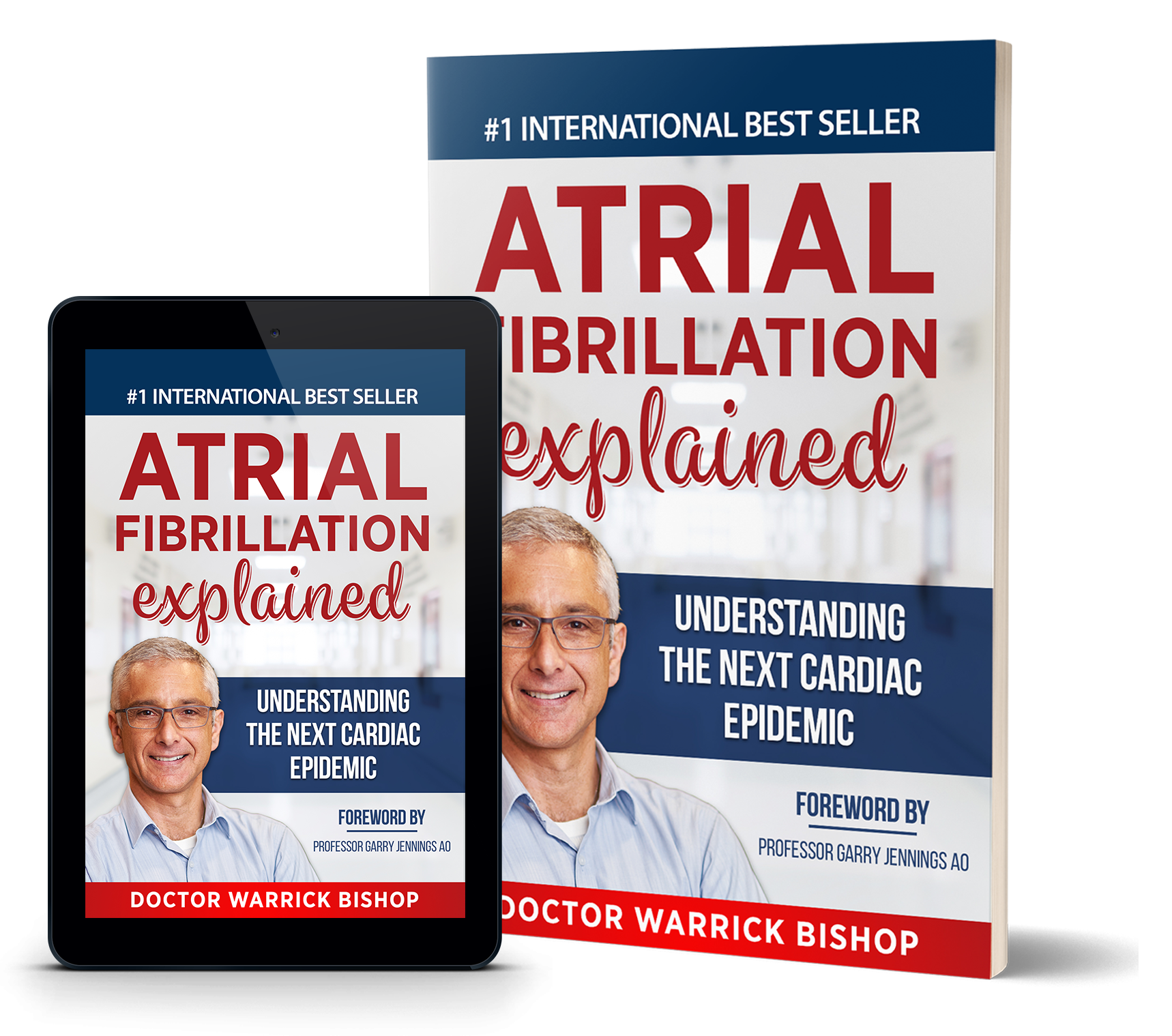
G'day, my name's Dr. Warrick Bishop. Welcome to my podcast and videocast station. Really do appreciate you tuning in. And today I'd like to touch on a couple of different bits and pieces. The title of this podcast is Coffee, CAC and Questions. So let's address them. Let me start with the questions. So let me say, first of all, I'm really grateful that a number of the listeners on a regular basis reach out and ask questions. where people's interest lies. So I'm always happy to try and give people the information they need. It also gives me some feedback and lets me know if I've not been able to explain something clearly. So please don't be shy about getting back, letting us know if you do have any queries or questions about particular podcasts. And I'm always interested to know if there are any particular topics people would like covered because I'm basically hoping to be a resource for people to save you jumping on the net and getting potentially mixed messages or messages that may have an agenda behind them. So it is my pleasure and privilege to try and answer questions and provide information on topics. So, as I said, don't be shy. The email is info at drWarrickbishop.online. info at draricbishop.online. And if you're stuck, just jump onto my webpage and leave a message there and it'll get to me. Having said all that, I really am also grateful that people listen. I put a fair bit of time into this. I'm constantly trying to think of good information to share and it really is heartening. When I do get feedback and people let me know that they've listened, let me know that they found the information helpful or informative. So again, really do appreciate that. And let me know because I often do these podcasts in a room all by myself when there's no immediate feedback, as you might imagine. So some feedback is always good. And if I'm on the right path, let me know. If I'm not, let me know and I can correct it. So I'm going to jump into the questions first of all. What I'd like to do is answer a question from Colin, who's asked something I'm guessing about atrial fibrillation, where he wants to know whether AV nodal ablation is a better option than using drugs. Well, when we think about atrial fibrillation, we're thinking about the top chambers of the heart, the atria, fibrillating, twitching, not working properly. out of sync, going rapidly and irregularly irregular. The electrical signals from the atrium then bombard a, if you like, an electrical gateway between the top part of the heart and the bottom part of the heart. That electrical gateway is called the AV, standing for atrio, atrium at the top, ventricular, ventricles at the bottom, node. It's not a tricky name, AV node, but that's the... electrical gateway separating the top part of the heart from the bottom part of the heart that electrical gateway is incredibly important because one of the things it does is make sure that the heart doesn't beat too quickly it acts as a capacitor so it stops the atrial fibrillation being directly transmitted to the ventricle because atrial fibrillation being transmitted to the ventricle would give us ventricular fibrillation. That's not consistent with life. So that AV node is incredibly important in terms of separating and filtering some of the atrial activity from the ventricle. Colin's question is, should we ablate that AV node and put in a pacemaker to get around that issue of atrial fibrillation rate control? Well, in general terms, Colin, We tend to use drugs. The drugs appear to be safe. They tend to be good at regulating and slowing down conduction through the AV node so that we can protect the ventricle and we can get people in most situations to a well-controlled rate. In general terms, we would look at AV nodal ablation as a fairly last option in the situation where we can't slow the ventricle down and that AV node is not acting as a capacitor, is not acting as a slowing down gate as it should for that individual. Happy to cover that in more detail, but I do have a lot of that information in my atrial fibrillation explained book. So if you've... not have the chance to have a look at that and you'd like to have a look maybe get it from your local library it's also available for purchase online but i do talk about that in there and that would give you lots more understanding in that space another question i got just recently was from jeff and this is in follow-up to me talking about cholesterol lowering and the potential impact on the metabolic pathways that drive production of coenzyme Q10 and one of the sub-classifications of vitamin K2, a maniquinone 4. So both coenzyme Q10 and vitamin K2 maniquinone 4 are generated through the pathway where statins work. Jeff asked if, firstly, we know the extent that the statins alter vitamin K2 and coenzyme Q10. Well, in fact, I was reading about that just the other day, Jeff, and it turns out that there's a really intricate study done where they've done muscle biopsy looking at individuals on statin before and after. statin introduction, measuring coenzyme Q10, and also measuring the impact of coenzyme Q10 supplementation. I'm actually going to put this in the next book that I'm writing, which is going to be about cholesterol. And you might want to check that out when it comes, because I think this will be a really comprehensive book I'm writing with Associate Professor Karam Kostner, who's a good friend and an Australian. expert and world recognized expert. We really want to give people all the information they need about understanding where cholesterol fits. So this is an important bit, and I reckon it'll make it to the book. What that study showed, Jeff, was that the addition of statin didn't seem to alter coenzyme Q levels within muscles. The addition of statin with side effects didn't seem to relate to changes in coenzyme Q levels within muscles. And additional supplementation of coenzyme Q10 didn't seem to relate to changed levels in the muscles, nor measurable changes in coenzyme Q10 levels if there was an alteration in symptoms. What does that mean? Maybe it means that our techniques for measuring coenzyme Q10 are just not sensitive enough. That's a possibility. Or maybe coenzyme Q10 question is far more complicated. When it comes to vitamin K2, we don't know. I threw those concepts about alteration of vitamin K2 levels related to statin interfering. with the HMG-CoA reductase pathway and with ezetimibe altering absorption. I threw that out there as a thought bubble more than anything. I've not seen any data on it, but I will keep an eye out. And if you see something, please share it with me. Jeff asked two more questions. Let me finish off for Jeff. One of those was whether bembedoic acid has the same pleiotrophic effect as statins. So for those listening and want to learn a new word, pleiotrophic means that the effect is based on growth or change or structure over and above cholesterol, luring, or together bembedoic acid is an agent that works in the same pathway as statins, but upstream, not downstream. upstream, which means everything that the statins could impact, bembedoic acid will impact by virtue of the fact that it's further upstream, if that makes sense. So Jeff's question about bembedoic acid and what we might expect is that we don't know about those pleiotrophic effects. for bimbardoic acid. Pleotrophic effects were used in marketing of statins, particularly a decade or more ago when there was a number of different statins on the market. And pravastatin in particular, the manufacturer of pravastatin particularly wanted to advocate pleotrophic changes. To be honest, I'm not sure that story has really continued. really seem to focus predominantly on LDL cholesterol and have moved away from pleiotrophic benefits of statins to really LDL lowering to target for individuals as our main concern. Having said that, we know that bembedoic acid is not quite as powerful as the statins. It gives us a... 30% LDL cholesterol lowering, something in that order. Statins at higher dose can give us about a 50% LDL lowering, so they're more powerful. So I hope that answers the second question about pleiotrophic effects. Jeff, third question was, does bambidoic acid, in terms of its pathway, have an impact on coenzyme Q10 and vitamin K2? Well, as I've just explained, bambidoic acid works in exactly the same pathway. As the statins, it's just higher up that pathway. It's upstream, if you like. And so it will have exactly the same potential effects. We just have to watch that space in all honesty and see where it goes. Well, there's heaps I've just covered there in terms of answering those questions. Again, thanks so much for reaching out and giving me the opportunity to do that. I do invite people to let me know. If you're enjoying the podcast or not, if you've got any questions or not, and if you've got any topics in particular you'd like me to cover, I'd also be super duper grateful if you were happy to share the podcast, particularly if you found it beneficial, because I'm trying to build my rankings up a bit. And if you think it's valuable, why not share it? All right, I'm going to jump on to coronary artery calcium scores. And I just want to touch on a paper that came through fairly recently into my inbox. It's cardiovascular events with absent or minimal coronary calcification. This is from the MISA group. And the MISA group, you may or may not know, the multi-ethnic study of atherosclerosis. This has really been... run by Matt Budoff and some of his colleagues in the US. They've generated so much information through this cohort of people that they've tracked with imaging information. The upshot of this particular study is that when they took asymptomatic persons with absent or minimal coronary artery calcium, they're at very, very low risk. So a zero score remains a very powerful negative predictor of future event. But when the score went to one to 10, which doesn't sound like a lot, particularly when we think of a score of 100 as a pretty intermediate to high risk score, and we'd probably treat a score of 300 as as high as someone who's had a previous heart attack. So we definitely treat them and a score of 1000 as. very high risk, and we'd certainly be looking to drive very low targets. A score of one to 10 doesn't sound like a lot, but believe it or not, this increases the risk compared to a calcium score of zero by three times. Now, it's a pretty low starting point, but it does show you that there's a tick up as soon as you start to get plaque in those arteries. Well, what was the last thing I was going to talk about? Coffee. Turns out about a billion people a day enjoy coffee. It is psychoactive. It does have all sorts of effects. It can increase your nitric oxide levels. It is a bit of a vasodilator. And of course, it wakes us up. That's what most of us start the day with. The question that I get pretty regularly, though, is, is it good for you or not? And I do know that coffee has within it a thing called Cafestol. Cafestol. And I've covered this in a podcast before. So if you're interested, put Cafestol in the AI bot on my webpage and look it up and find which podcast that's in. But Cafestol is a compound from coffee that can actually raise LDL cholesterol. Is that a problem? Don't know. There's been all sorts of studies over the years that have looked at coffee. and impact on cardiovascular health. And a 2013 meta-analysis looked at 30 plus studies in more than a million participants and suggested that there was lowering of cardiovascular risk for regular coffee consumers. Well, we've got even more information that came in a study released relatively recently. The study was called the Habitual Coffee, Tea and Caffeine Consumption, Circulating Metabolites and the Risk of Cardio. metabolic morbidity study that appeared in the Journal of Clinical Endocrinology and Metabolism in recent time. Well, this was a very, very comprehensive study. It looked at thousands of people, in fact, and combined data from US Biobank, very accurate diarising of coffee consumption, and even did lots of blood tests so that they really started to nail down where their benefit maybe lies. And really importantly, if there is a benefit, what might be driving it? Well, here's the interesting thing. And this is what some of the previous studies have shown as well. It looks like there's a little bit of a J curve when it comes to coffee consumption, a J curve, meaning it starts with zero. being what we'd expect for the non-coffee consumption participants. But as we see people consume one, two or three coffees, relative risk of cardiovascular disease goes down. As we see people go past four or five coffees, relative risk comes back up. So going down and then back up a J-curve response, meaning there's a bit of a sweet spot. Not meaning that you should put sweetener in your coffee, but a sweet spot for coffee consumption. They really looked at hundreds of thousands of people. They identified that people who drank a bit more coffee tended to be a little bit older, were more likely to be male, often slightly more likely to engage in physical activity. Maybe the coffee stirred them up. They tended to eat less processed meat, fewer vegetables, some other bits and pieces, which, including alcohol, were all adjusted for through the study and it really appeared that that u-shaped curve or that j-curve put a sweet spot at around three cups of coffee or tea a day where the consumption of caffeine was about 250 milligrams remember standard energy drink contains about 120 milligrams of caffeine um so This study, which looked very closely at potential benefit for coffee, caffeine, seemed to clearly demonstrate and support what other studies have shown that there is a sweet spot of a number of coffees per day that probably does reduce risk of heart attack into the future. And this has shown pretty clearly. This most recent... research however looked at measuring metabolites within the blood they looked at nearly 170 different metabolites within the blood well the really interesting one that pops up from their investigation is vldl now everyone who's listening to this podcast knows what ldl is low density lipoprotein. So what's VLDL? Well, V just stands for very. So VLDL is very low density lipoprotein. And it turns out that coffee has a significant, or caffeine, I should say, has a significant effect on lowering VLDL. And this VLDL, because it's linked to LDL and carries cholesterol around the body, has a link to cardiovascular disease. So caffeine luring VLDL will translate by sheer exposure of that particle to reduce cardiovascular events. But that amazingly is not all. It turns out that as they looked at some of the other metabolites, they found that histidine, histidine, H-I-S-T-I-D-I-N-E, which is an amino acid, which in low levels has been associated with increased cardiovascular risk. So an inverse relationship seems to be raised by caffeine as well. So raising histidine levels, lowering cardiovascular risk. Well, a couple of nice reasons why we might enjoy. a couple of cups of coffee a day to keep us well. I hope you found that interesting and informative. I've answered some questions. We've talked about CACs, we've covered caffeine, and I'm going to wish you the very best. Again, thanks so much for tuning in. Till next time, I hope you live as well as possible for as long as possible. Take care and bye for now.