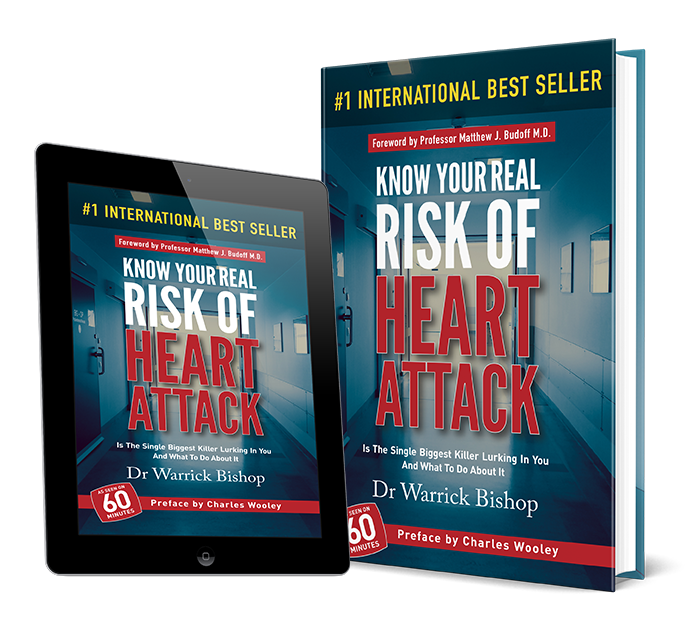
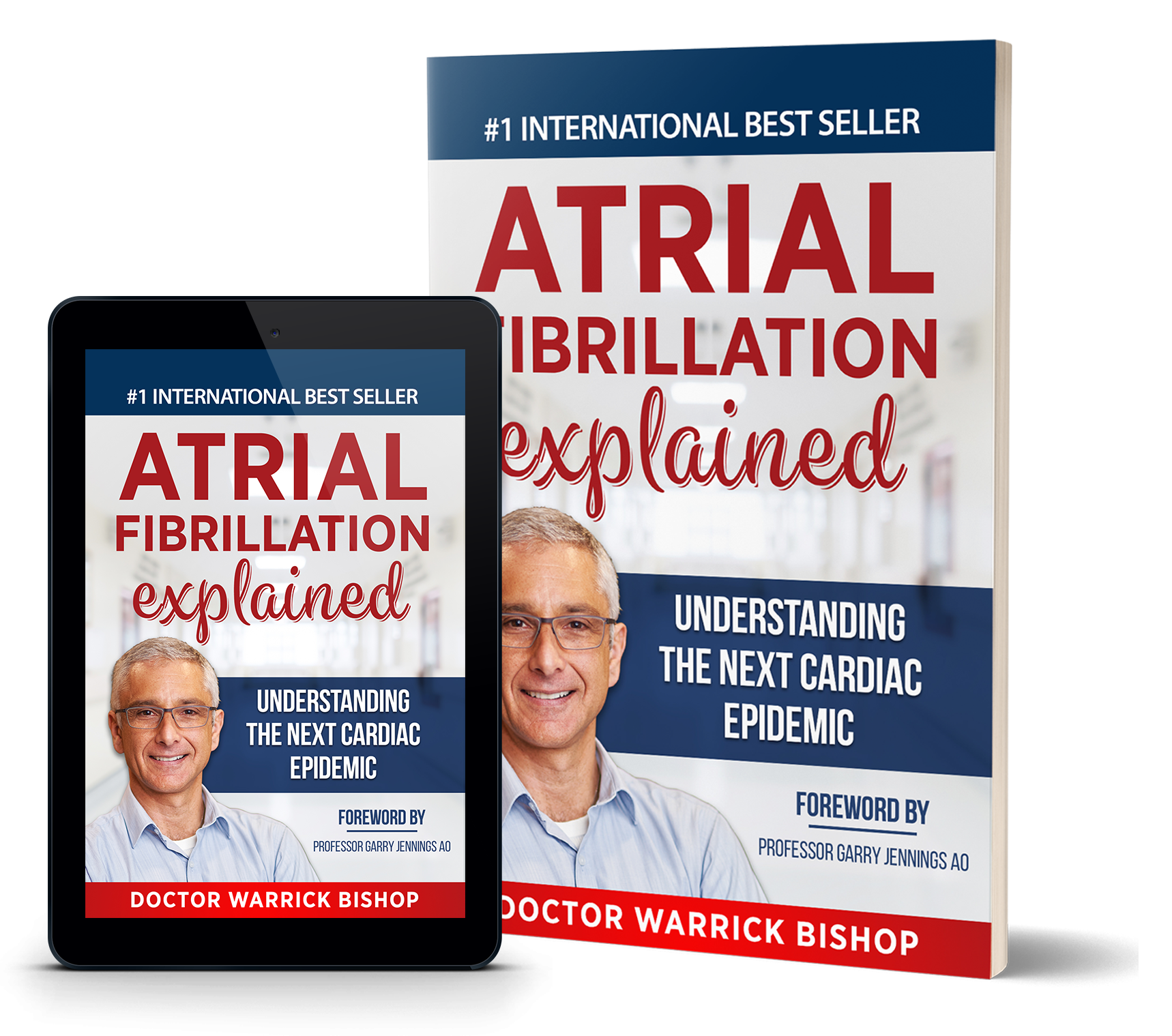
Welcome, my name's Dr. Warrick Bishop. I'm a cardiologist, an author and a keynote speaker. I'm CEO of the Healthy Heart Network. I'm all about trying to help people live as well as possible for as long as possible. Heart disease is huge in Australia. Every 20 minutes someone suffers a heart attack. Most of these could probably have been avoided if only we knew what to do. This podcast is all about helping you understand. blood pressure, weight, cholesterol, for better health. If you enjoy this podcast, I would be honoured for a five-star review. You can share it with your family and friends. It may well save someone you love. I'm Carl Treach and I'm joined by my co-host and co-founder of the Longevity Lounge, former world Ironman champion, Guy Leach. Today, we're joined by renowned Australian cardiologist, best-selling author and keynote speaker, Dr. Warrick Bishop. Dr. Bishop is passionate about preventing heart disease on a global scale and specializes in preventative cardiology. He's authored several bestselling books, including Know Your Real Risk of Heart Attack and Atrial Fibrillation Explained. So Warrick, welcome to the Longevity Lounge. Thanks very much for having me. Good to see you. See you in the flesh, actually. We've known each other a long time. Feels like three or four years at least. At least. Yeah, more I think. So Warrick, this is one of the most anticipated episodes of the Longevity Lounge of all of our 10 episodes or whatever we have so far. I know a lot of our listeners are interested in preventative medicine, interested in taking the steps that they can take to look after themselves and not be in a position of repairing their bodies in a way that they possibly could have avoided. You're doing a lot of work in preventative heart medicine. We'd like to know why. We obviously want to get to what you do as well, but how did it all start? I landed in cardiology in a rather circuitous way. I actually thought as a young fellow I'd be in engineering or drafting. I just had an eye for maths and drawing. One thing led to another and engineering didn't look... For me, after some work experience, I ended up having the marks to get into medicine, thought I'd sign up, seemed like a good idea at the time. Barrelled through uni as you do, fair bit of work, but a lot of fun as well. Got into specialist training. I had such a positive attitude about that at the time that my motto was smart enough to get in, dumb enough to do it, to give you some idea of how hard we used to work. But the reason for telling you all that is as you go through the specialty training, you get the chance to try different areas. And one of the first areas I went into was hematology, which is blood. And it was amazing. At the time, there was the beginning of some of the cellular interventions for curing people. So a thing called hairy cell leukemia, I don't expect you to know about it, very rare. They were treating it with a vitamin A derivative. And this was like Lancet, New England Journal stuff. These are the leading medical journals that we read. Super exciting. How long ago was this? Back in the early 90s. So I'm thinking, gosh, I'll be a haematologist. Super excited. Sick people, bone marrow biopsies, urgency. And I sat in the Grand Rounds, which is where you discuss patients, show the slide films. And it became very apparent to me very quickly that as they talked about what was on the slides, the different... cells stained with different browns or reds. And as they described them, I realised... that I was colourblind and I couldn't see a single thing they were talking about. Can you see the magenta staining of the polymorphs? And I was just squinting at this. Anyway, long story short, I then rotated through a heap of other things. This is not for me. Not for me. I got through a lot of stuff. I got to cardiology where you can be colourblind and stuck with that. It was an incredible time in cardiology. Around the same time... we had these clot-busting medications. So you can imagine someone coming in, looking sick as a dog, squirt some stuff in through the arteries. An hour later, colours back in the face, blood pressures up, clot had been dispersed from the artery. Amazing stuff. Coronary care units with balloon pumps going. Very exciting. And same time, stents were coming on the picture. Balloons first, then stents. And it was a real environment of... making a huge difference acutely so i jumped into it i did that obviously for a good number of years and as you're probably aware a lot of medicine is driven off a tow truck mentality we we wait until something goes wrong because how do you feel kyle well i feel fine thanks um how are you feeling leachie i'm pretty good have you thought about getting your heart checked no i exercise regularly i'm fine we tend to act with health in a reactive way. And I think tow truck mentality for health, although defibs are incredibly important, it's not the best way to do it. You want to try and avoid that. It's funny you say that because, I mean, our first guest was Wally Masseur. Australian tennis, great. 61 years of age, wasn't he? On his birthday. On his birthday, yeah, that's right. And he literally said in our chat that it was only the year prior that he'd actually got and got his heart checked for the first time. When he was 60, his wife's a nurse and he found that he had some heart issues. Trains fit, trains every day and all the rest of it. So even that mentality is still there now. Yeah. So with that as a backdrop, about 2005, I was driving to work. It was a Sunday. The City to Casino Fun Run was on in Hobart, literally along the road that I had to drive to get to the hospital. And I saw a commotion, a ruckus by the side of the road, an ambulance, a collection of people. I thought, well, it could be a medical problem. I'm a doctor. I might stop and see if I can help. Turned out... One of the runners, a 53-year-old man, had literally collapsed during the race. His heart had stopped and he was resuscitated. I was part of that resuscitation. The ambulance were there. There was a couple of doctors and nurses actually in the crowd who helped as well. This guy did so well. that three days later he was on the front page of the paper, so he was well resuscitated. Beautiful picture of him smiling in bed, modest as I always am. I had a copy of the paper, took it to my office and just casually showed the staff, only to have my secretary say, Warrick, you saw this guy 18 months ago. And at that moment there, the hair on the back of my neck stood up. Crumbs got his notes out, right? Because I don't know if people realise, but as a doctor, if something goes wrong... it really impacts you. It really... It's one of your ducklings. It really, really impacts you because you think what hand have I had in someone else's wellbeing? I went back and I looked at this guy's notes. I'd actually done everything right, okay? So he'd come in with some funny pain. I'd done a stress test. His blood pressure was up a little bit. I'd put him on a blood pressure therapy. I'd reassured him, literally reassured him, to then 18 months later be standing over him. with him literally dead by the side of the road. So this confronted me enormously and I realised that what we're doing wasn't right and it opened my mind to how can we be better at predicting these high-risk people? Where did you go wrong in your assessment based on him? Well, at the time I did everything that was available and so the standard response to someone who had some funny pain was to put them on a treadmill test. And people think if you exercise well, and this is a fallacy actually, if you exercise well, you should be fine. That's rubbish. It's absolute rubbish. 40% of all heart attacks, which is nearly half, 40% of all heart attacks occur in arteries that are not narrowed at all in terms of limiting flow until the moment that the plaque ruptures and a clot forms at that site. This guy, his name's Gary. This guy that morning put his shoes on, tied up the laces on his sand shoes, expecting to run 10 kilometres because he felt okay. Where I went wrong is that at the time we didn't have the technology to do anything better. You're right. And literally the next couple of years as I was confronted by this, cardiac CT imaging became available, the technology advanced, and if you think about it, the heart beats. So to grab a 3D imaging... image of a beating heart is pretty tricky. So the technology is only relatively recent to, if you like, freeze the heart so we can get a beautiful picture. That technology arrived and I suddenly realised this is the way to look at someone. who potentially looks well on the outside, but we can lift the bonnet, look at the engine properly and see if there's problems. And you can see the plaque on the arteries through that scanning to be able to then predict that we need to do more than what we're currently doing. That's exactly right. Yeah, that's exactly right. Because you see with fun runs, pretty much in every event, you get 10,000 people or more, someone's going to drop because it's a numbers game where a bit of plaque coming loose. It could happen when you're pumping your heart and your arteries are expanding and something unlodges and then you've got your problems. So the stats are even more compelling than that, Leachie. If you stand back and look at what kills Australians, one in four Australians die from heart disease, coronary artery disease, one in four, which should make us... Or go and get checked. Why would you wait until something happens when the first event could be a heart attack? It's your most prominent thing to get checked. And it's simple. It's really simple. If your heart stops beating, you die. It's super simple. And of those one in four, 20% of all heart attacks occur in people 65 years of age or under. Well, Dean Mercer's my wake-up call. You know, he was 47 and fit as a fiddle and raced him through my whole career pretty much. And when he dropped and didn't survive and it was a heart issue, I just went, well, this can happen to anyone. But the kicker was that he hadn't been checked. Yeah, absolutely. Because when you're under the age of 50, you think, oh, well, I don't need to worry about it yet because I'm not at that number. But what age should you get checked? Is it like at 30 or 40? Yeah. What do you think? Look, that's a really valuable question. And look, in my ideal world, we should be screening all men at, say, 50 years of age and all women at 60, without question. A little bit like we get our... bowel cancer screening test kit in the male at 50 years of age. The problem with that is Dean Mercer doesn't make it because he's 47, right? So when we take those routines, our ideal world, we then apply over the top of that potential risk enhancers. So if the cholesterol is elevated, pre-diabetes, bad family history, these sort of things that could be contributors to increased risk, I would put to you that there's a very good chance if we looked at Dean Mercer's... his cholesterol levels would be high or there was a family history or some such. So that we would say to him, look, maybe we'll check you at 40. You know, anywhere from 40 years on for men, 50 years on for women is not a bad starting point. Absolutely essential in my world at 50 and 60 respectively. And the reason why there's 10 years difference is basically... Women follow men by 10 years when it comes to coronary disease. Actually, it's the reverse for osteoporosis. When you think about that 10 year... Is that lifestyle driven? No, it's just hormones actually. If you think about people's timeline and men moving into that risk range at 50 odd years of age, then you add the other risk factors over the top. So really high cholesterol might make that risk hit a bit earlier. Smoking brings it forward. Ten years. Those sort of shifts, if you like. A lot of our listeners are fit. They're trained athletes in your language, I imagine. Including, you know, I went to school with Emma Carney who ended up with a pacemaker after, you know, Greg Welsh was the same. World triathlon champions. Both of them. I've heard of their stories, don't know the details. Yeah, well, and they're both around today, which is terrific, but they both have pacemakers and had them. Emma was probably 40 when she had hers. That's something that I'd love to understand a little bit more. Was that this ventricular tachycardia or whatever it is that would put her in that position? Is there early warning signs for that? Is it atrial fibrillation at its end state? Help us understand. Yeah. So first of all, a bit of anatomy. The heart has four chambers and basically two chambers. that comprise the right heart and the left heart, easy to think of the heart almost as two pumps. Each pump has a pre-pumping chamber, which are called the atria. They're the top chambers, if you like, and the main pumping chamber, the bottom chambers, if you like, they're called the ventricles. Ventricular rhythms and atrial rhythms are originating in different places, so they're quite different beasts. A ventricular rhythm, if your main pumping chamber is playing up, is life-threatening. And in fact, cause of sudden cardiac death and arrest and needs a defibrillator. An atrial arrhythmia is an inconvenience. It has an impact. It alters the pump function, but doesn't have that, you know, sort of Damocles immediate threat of life and death, right? So they're slightly different. Interestingly, atrial fibrillation is linked to athletic training and... What we think is occurring, particularly as athletes, endurance athletes in particular, spend a lot of time training. Inflammation is part of the exercise process, although exercise reduces inflammation. It's a catch-22. If you do too much exercise, it goes the other way? Correct. Could go the other way. It does. It does. So exercise is really good for reducing inflammation. Too much exercise can drive inflammation. Why are we worried about inflammation? Inflammation can... lead to what we call scarring. And scarring then changes the integrity of the communication of the cells within the heart. Now, I don't know how much you know about cells within the heart, I don't know how much your listeners know, but there's this wonderful sort of way the heart's put together. every cell of the heart out instantaneously and lay them on a nice laminated table, every single one of those cells would beat independently. I've seen a video of that. It's incredible. It's a little bit freaky, actually. It seems creepy. The amazing thing is when you put them all together, they've got these connections and they become what's called a syncytium or a single organ. So they all communicate. So the cells that literally beat the fastest then beat the drum that the rest of the heart. And does that mean that if you've got an inflamed heart and those cells are inflamed, that the integrity of what that cell does changes? It means the communications between those cells can be impacted. Once you alter those communications and you haven't got that beautiful flow, you get eddies of electrical activity that are not flowing in the right way. Those eddies or short circuits, if you like, can then help contribute to mischief. So atrial fibrillation. with endurance athletes. Which is what Carl's got. Yeah. So he's a candidate for that. A combination of inflammation from the exercise, but also partly related to the work that you do and the adaptation of your heart to long-distance training. Because as you exercise more and more, your heart starts to, particularly in endurance stuff, specifically in endurance stuff, your heart will dilate. So it becomes a bigger bucket. So the heart dilates, the chambers dilate. If they become inflamed, then you've got scarring. Plus change in shape of the chamber, you're increasing your risk of abnormal electrical activity. So that's the outro. That makes sense. This program is proudly brought to you by Ascend Performance Collagen Protein. Ascend Performance Collagen Protein uses the highest quality ingredients, is dairy-free and tastes great. Each serve contains 25 grams of protein and includes tenderfort for joint and ligament support as well as gut matrix to help support a healthy and diverse gut microbiome using a unique combination of pre, pro and post-biotic ingredients. To find out more or purchase, go to ascendperformance.com.au. Can I ask you a couple of questions on that too? Because I know the incidence of atrial fibrillation is a lot of people walk around without knowing that they've got it. It's only people that are sort of, I know because I can feel it, particularly after a race or something. It's quite, I feel like I've been poisoned essentially. So look, atrial fibrillation is such a significant condition. I've written a book about it because it probably affects 300,000 to 400,000 people in Australia. The stats are that it affects about 1% of the population. Wow. But it affects 15% of the population. above 80 years of age. And atrial fibrillation is the cause of approximately 30% of all strokes. So if you think of how devastating a stroke is, how many strokes occur across Australia, that is an incredible disease burden. So the scary thing, Carl, is you're exactly right. Many people don't know they have it. So the situation where people turn up with a stroke and then are found to be in atrial fibrillation is... outrageously common. How do they not know that they've got it? If your heart rate jumps. Wouldn't you just straight away have enough awareness? You know, and I know because we are so familiar with our bodies. I can tell you what my heart rate is right now without actually looking at my watch. So you could jump 15 beats. Someone who's not aware wouldn't know that they've jumped 15 beats in a minute, do you think? I can only speak personally. I mean, you've got hundreds and thousands of patients right now. Would that be fair to say, Warrick? So, look, this is really – it's a very weird space. There is no question that some people have a real awareness. And some people don't. Because if you walk up the stairs, for instance, most people's heart rate would jump 15 beats. And you can feel that. You feel a little bit laboured without being... out of breath. But you notice the difference, right? I'm assuming that if you've got AF that you're going to jump enough that you would feel something. There's probably a couple of things. I might just jump in on this just for my own. Yeah, I'm interested in just whether I've got any issues. Oh, you've got issues. But not to do with the heart. No, not at all. We'll come to that. Touche. But I have an overwhelming feeling of fullness in my neck that happens when I have to cough. and it's sort of the coughing I imagine or what my cardiologist tells me. It's my body trying to kick my sinus rhythm back. I'd love to give you on just generally people being aware and not aware. I've got a business partner who's in constant AF, and it's much more severe than mine. The statistics that we found through his investigation was he was five times more likely to have a stroke. Now, when you hear that sort of language, it does put the urgency into the conversation, and particularly if we're at an age now where our parents, or our friends have had a stroke and we look at, to your point, the catastrophic implications of that. It's something we want to avoid at all cost. The medication available for AF, I'd be interested in that and I want to talk about the technology that's available to all of us through Apple Watch in terms of ECG readings and be able to... identify AF before it happens. Yeah, a bit there to unpack. Let's talk about why AF causes a stroke first. Just for those listening, it is sort of interesting. The atria, those top chambers, have this redundant outpouching. We don't know from an evolutionary or teleological point of view why it occurs, but there's literally like a little outpouching. We call it an appendage or an oracle. Oracle is another word for ear because it's about the shape of an ear. And the atria have these little outpouchings. Goodness knows why. But when your heart's in normal rhythm, they cause no problem at all. They happen to be very handy for coronary artery bypass surgery because you can stick the tubes in through there. So maybe there is an evolution. Maybe there is a reason. They knew in advance. Exactly. However, the significant thing is if your heart goes out of rhythm, then blood can sit in this little appendage. And if blood sits still for any period of time... Blood can clot. So if that bit of blood clots in there and then eventually breaks off, it can float into the ventricle, the main pumping chamber, to be squirted out into the brain. Absolute disaster. Yeah, right. Fascinating. Yeah. Little reservoirs that sit there causing no issues until something could go very wrong. So that's how we get the stroke. You asked about the Apple Watch. There was one other thing you asked. Medication. Oh, so the medication that we use is there's three types of medication for atrial fibrillation. One type of medication tries to keep you in normal rhythm. So if you've got a rhythm disturbance, we want you to remain in normal rhythm, so we give you an anti-arrhythmic. Arrhythmia is out of rhythm, rhythm is in rhythm, so an anti-arrhythmic. So there's a couple of different... Flecanide, for instance. Flecanide, perhaps? Perfect. Is that what you take? That's what I take. Yeah. So flecanide, beta blockers, calcium channel blockers, amiodarone, sotolol. We could do a podcast on that. And we will. In fact, I've written a book on it, Atrial Fibrillation Explained, if I can have a plug. So we use antiarrhythmics. We use rate-controlling medication because the heart, if the top chamber is out of sync, out of rhythm, it shakes, trembles. The word we use is fibrillate, but it's got a chaotic rhythm. And so those electrical signals are bombarding the ventricle very rapidly and irregularly. We actually call it irregularly irregular because it's all over the place. I often say it's a bit like a white guy in a disco, but just completely out of rhythm. And so if that heart's racing and your heart at rest is between 100 and... 10, 140 beats a minute, that's not cool. So we use medication to slow the heartbeat down. And lastly, we use anticoagulants or blood thinners so people would be aware of warfarin. Warfarin was our foundational medication for years. And warfarin's origin, obviously, Coumadin, we know it as rat poison as well, actually. So you need the right dose. So we now have newer agents called... Noax, which pertains to them not necessarily working the same way as warfarin, and we use those to keep the blood thin. Okay. Apple Watch is a really interesting space, super interesting. The reason why it's super interesting is there has been a big Apple Watch study, as you're probably aware. No. Okay, so. That was just a random question that was right on the mark. So there's been a big Apple Watch study, absolutely fascinating. I think they did thousands of people, maybe 10,000 people, so huge because of the reach of Apple actually. And what they found was that they probably did pick up a little bit of AF, not a lot. They got a lot of false positives, meaning that people were flagged but they didn't have the problem. The cohort they had, as you might imagine, were relatively young people because they had the tech and, in fact, it was the old people who needed it. I think, Carl, what's going to happen is we will use that technology without question, but it's not refined and we don't have a nice way to deal with it. But, look, I'm... I've been involved with a group called Talias, who have the rights to bring a smartwatch into Australia called Cardiac Sense. And this is a very, very precise tool using similar technology, photoplethysography, PPG, to track PPG and their algorithms, sort of machine learning algorithms to evaluate rhythm. And these things are very high quality and really... on the horizon of what we'll see people wearing because these devices will come almost certainly. We're not quite there. I think just to finish that little subtopic out, when I went to my cardiologist, my heart was in rhythm. The only way I could prove that I had atrial fibrillation was from a readout from my Apple Watch. Yeah. And he took one look at it and said... Perfect. I think whatever the technology is, it's just nice that we've got that early warning system available. Look, there's a device called... I think it's called... Core device, C-O-R-E, and it's a little tab, little flat disc sort of thing, rectangle. You put your finger on it, two fingers on it simultaneously, and it can do a recording. I think it links up to your phone or your watch, and that gives a reasonably good electrical trace. Okay. So, yeah, the technology is going to be... At the moment, Leachie, the answer to how we identify who's going to have AF or not is we try and check rhythm as often as we can, opportunistically. So people who are 65 years of age or over, pretty well every time they see their GP, they should either at least have their blood pressure checked, looking for their pulse and checking the pulse as regular, and if there's any question, have an ECG. And the really weird thing about people being aware or not... It continues to confound me. So some people have an amazing sensitivity to their heart. They go into a tiny bit of AF. Or the other arrhythmia that's probably even more common are ectopic beats or beats that are out of place. So I have patients who have one or two ectopic beats a week and they fall over, they drop their shopping, they can't control it. And others who every second beat is an ectopic beat and they don't feel it. And they can just get on with life? And they just get on with life. It's bizarre. The only observation that I do understand is people who have atrial fibrillation and have it symptomatically, and so you work hard to keep them in normal rhythm, if you get to the stage where, and time erodes your threshold to atrial fibrillation, you've got that, because if 15% at 80 years of age have it, then as you get older, you're likely to do it. So if you get it and you're progressing in age, it will come back. you will end up, Carl, in atrial fibrillation one day permanently, almost certainly, unless technologies change. Sobering? Unless technologies change in a completely different way in the next five or ten years. Despite medication? Despite medication. It'll just happen because it's a threshold sort of phenomenon. Is that something for Carl and listeners that exercise a lot that he's just got to be wary about his heart rate and pushing? At that maximum level? Is there certain criteria that come into causing him to go out of rhythm? Well, as we were saying before, the really long endurance stuff probably drives it to a degree. But not in everyone, you see. Not in everyone. And we'll come back to VT, actually. So you've sort of got to know your own space a bit and just look at what's brought it on before and have your own. understanding of where your weaknesses could be? Well, unfortunately, you won't know your own space until it hits you. That's the whole problem. And I think what will transpire, and this is what we'll talk about with VT, is there'll be a collection of genetic markers that will become apparent with time that will say, Leachie, you're less likely to get atrial fibrillation with endurance training, but... Carl, you might be running a risk and we'll know that from a genetic panel. That's not out there yet, but I suspect it's not far away. Isn't that the future of medicine where you can actually sort of personalise your own background and your future and deal with it accordingly? Absolutely. But remember that genetic information then needs to be matched up with the epigenetics. You've driven an epigenetic, Carl, you've driven an epigenetic scenario where that endurance training has allowed those genes, whatever they might be, to be expressed. You might have just tried too hard. Your lack of ability and your keenness to go well and be like me has just meant that you've gone and fried your heart. A hundred percent, but I'm one of thousands and thousands of middle-aged men that are overcompetitive, trying to strive for glory that I've never realised. I was literally just trying to get a shot across the bow there. That's all I was doing. I know. So let me finish off because I was just payback for a previous podcast. One of the interesting things about this atrial fibrillation is that the people who work really hard to or who come and report. in a distressed way that they've got their AF. If we lose control because you get to a point where too much intervention then outweighs risk and benefit for that individual, you accept that they may well end up in AF long term. Six months down the line, they no longer have the symptoms, so the body adjusts. You know what's funny? I was thinking about you, Carl, being an athlete of sorts all your life, and I'm trying to put myself into your shoes, and your badge of honour when you're an athlete is your heart. You know, the irony in all this is that for a normal person, you don't think about that, but your level of fitness and what your heart can do under strain. So something that we work on where we're an endurance athlete is working under that threshold of lactic acid. So I would know that when I was doing a five-hour race, like a cooling out of gold or something like that, that... that my lactic threshold levels was about 170 to 175 beats a minute. And what that would mean was I could race and have my heart at 175 beats a minute and could do that for five hours and not produce lactic acid. But if I stepped up over 175 beats a minute, then my body would start producing lactic acid, which is the body's way of putting the brakes on. and saying, slow down, you're killing yourself. I think also that the... So my point is that I've still got that ability to be able to do that and not have any concern that if I wanted to go and be that person again, I could do that to a degree, but you've been limited, which is sad, right? I find that sad. It is on top of mind for me quite often if I have palpitations. Yeah. Because you'd be stressed going, oh, my God, I'm about to go up a hill on a bike. This morning. Do I push? Do I push or do I sit back and let this young guy go in front of me but I know that I can match him or beat him up there? It's just shithouse. I don't mind so much anymore. Anyway. There are a couple of pragmatics to that. One is our evolutionary blueprint was designed on... Our ancestors, who evolved three to four million years ago, they lived to 20, 25 years of age, absolute tops. So our genetic blueprint is made for us to get to 20. So Carl would have got to 19 with his heart and I'd be still kicking at 27. The dinosaurs would have got you for sure because you would have slowed down. So number one, all of us sitting here are way past our DNA used by date. So we are buying time. And this always amazes me when I talk to people about medication. Oh, I want to do it naturally. I want to do it naturally. I say, well, if you want to do it naturally, drop dead at 25. Just die early. Yeah, die early. Or would you like to participate in what we can do to modify that used by date? We might move into some of the things. Oh, second thing. It's really important. stuff you're talking about, we didn't evolve for that either. No, we weren't going for five hours hunting. This is not what man did. So there are two things that, I mean, I don't want to point it out, but they're not natural actually. No, I get that too. We live in our own little bubble. But don't lose sight of that because much as I appreciate my patients who really want to do the right thing. You've got to put it into context and not be overdoing. Sorry, Carl. No, but the thing with that, though, is that when you've been an athlete, you're a unicorn and you think differently. And the hard part, like Carl's got it worse than me in that he still wants to go and drive up that hill on a bike and test himself. Whereas I've got now to a point at 60 where I go, I don't give a shit. I'm happy to go and exercise and go to the gym for an hour for 45 minutes and pump weights or just ride around and someone can go past me on a bike and it doesn't hurt me like it used to. And you're still coming to grips with that. No, I'm pretty good with that. Just to swing back to the question about ventricular rhythms, Kyle, I think it's a bit like I was mentioning with regard to atrial fibrillation. I think there are what we're starting to find is some genetic markers that mean these people who are fit and well. carrying a gene that has a susceptibility to development of what we call dilated, big, cardio relating to the heart, myopathy, problem with the heart, heart muscle. And the prolonged training drives that chamber size alteration and drives inflammation and drives expression of these genes. But amazing, isn't it? These incredibly fit athletes having cardiac arrests and ending up with... We've had a couple of big-name tri-fleets from the 80s, probably two of the four of the biggest names, Dave Scott and Scott Tinley, that had open-heart surgery in the past two months. And it probably goes back to what you're talking about with that genetic disposition of being someone that if you become an endurance athlete, you've got more of a chance of something going wrong with the heart compared to maybe some other people. Yeah. And it's also really important for people to recognise that when the heart plays up, it's the blood vessels. They block suddenly, commonly called a heart attack, but that's plaque in the arteries, cholesterol buildup in the arteries. But it can be the muscle as well, and that ties in with the rhythm, which is what we're talking about, atrial fibrillation and ventricular fibrillation. So Warrick, for people listening, what are some of the basics that they can do around their heart? We've gone into specifics here, but checkups, how often, are there any signs that you need to look out for? We've all got stories on someone in our life that have heart issues. What do we need to know? Look, first of all, I'll jump on whether there's signs to look for. Honestly, if you're getting signs you've missed the boat in prevention, that's just too late. I really... so want to get across the importance of being proactive, really driving at a maintenance program, not a tow truck service. So if people are getting symptoms, go to hospital. You've just got to be sorted out. But know that that's potentially way too late. What I really want to see people do is be super proactive, a bit like if you get a text from your mechanic that says your car's done 20,000 kilometres, you need a check. You don't think, oh, well, my car's driving. Well, I won't even bother with a check because it'll be fine. No, you're just going to get it checked. So just on the servicing of your body and your heart, if your dad's had a heart attack or had some issue, Do we go, let's fast forward 20 years and get in at the age of 30 to get your first check up? Like obviously there's apples for apples, right, with people that have had a history in the family and then there's others that don't have that. So what do you prescribe for that? So that's a great question. Remember we said before already that in my ideal world every bloke should have had a scan by 50, every woman by 60, and we just bring it forward based on exactly that sort of story. And if you've got family issues, you just go, mate, you're better in getting in earlier than later. Absolutely. So at 30 odd years of age, you'd at least go and get a cholesterol check, check blood pressure, make sure you're looking after your weight. Because if you're not looking after your weight, you increase risk of hyperinsulinemia, increase sugars, increase high blood pressure, and that's all contributing to triglycerides, et cetera, et cetera. Another story. I think there's a real role for imaging the arteries. It just brings clarity. It is part of that personalized medicine that you spoke about. And you do that, right? So where could people go to be able to check that out? So I have patients who come and see me and I organise that. But what I realised is that many, many patients will find a reason not to go to the GP because they're too busy or their GP changes. Or sometimes their GP will say, actually, Carl, you look really fit. You don't need that test. So I created a platform, a web platform, and I'd love people to check it out and even share it. And that web platform allows an individual to jump online, put in some details, get an approximate risk score. And if they fall in an appropriate range, select to purchase a calcium score, a heart scan using a CT scanner in any major centre in Australia. And they can do that. It's a few hundred bucks without the need to see a GP, without the need to see a specialist. So they don't need to leave work. They need to sit in the GP's waiting office for an hour and a half. They don't need to pay a GP fee. But all that can be done. It's done online, gets booked. You simply turn up for your scan. Those results go to the GP. If it's all clear, you know, if it's zero, like I know yours is, Carl, mine, so is yours, Leachie, great. Check it again in five years. If it's not okay, it's a fantastic plan. That's a really simple way for people to go and just take all the... the time and effort out of it and just get it done really quickly. It's super easy. And look, it's working really well. I'm actually running a pilot at the moment with one of the private health insurers in Tasmania. And it's a fantastic way to get the ball rolling. So the other thing that people really need to do is look after their blood pressure. Blood pressure is so boring. No one ever checks it. GPs don't get excited about it. No one does. But as we said before, if your heart's beating 100,000 times a day, do you want it to be beating against a workload of 110 millimetres of mercury or 140? What is too high? It's a great question. I think I could talk about blood pressure a lot and I'm passionate about probably one of the most boring aspects of medicine. My colleagues love to put in stents and save lives and do operations. Me, I'm happy to treat blood pressure beautifully, right? The answer to your question is there isn't a perfect blood pressure. If we took a 12-year-old girl and a 90-year-old bloke, what's perfect? Of course, they're different. So there's a range. For every individual, there's a point we're below. that particular level, their blood pressure is too low. So every time they stand up, they're a bit lightheaded. You can't function like that. But above that, there's a huge redundancy. You can be 5%, 10%, 15%, 20%, 30%, 40% higher than that position, have no symptom at all. When you're really, really high, you know, you've got a headache and blood's coming out your ears and your nose, that's a disaster in hospital. What I try and aim for, Carl, is to bring blood pressure down as low as possible in my patients so that it sits near that point, which is the cutoff for too low, where they would be lightheaded. So I often will treat patients aiming for them to be a bit lightheaded when they stand up once a week, once a fortnight, when they know they're a bit dehydrated. And I really want to get to blood pressures around 120 or below regularly. That's super important because the current standard is 130 systolic. So would you want 130 or 110? I'd be much happier with 110. That's where mine is. And people grizzle about taking a tablet for blood pressure. I tell you, these things, they reduce stroke, they reduce heart attack, they reduce atrial fibrillation, they reduce cardiac failure, they reduce renal failure, they reduce risk of dementia. Wow. Wow. Compelling. And simple. And the sooner you start it, the better it works. Because if you think about our health journey as a course, then if you're a couple of degrees off on that journey, several decades out, you're a long way off. The sooner you get that right, the sooner you're in line and you'll get the best benefit from it. We could talk all day. Everyone's interested in the heart, right? We'd be great to get you back on again. I know that you're a student of longevity. You're a fit, healthy guy that looks after himself. So thanks for your time today. Really appreciate it. And we will get you back on very shortly to do all things longevity. Yeah, I'd love to. Did you know that coronary artery disease kills one in four people? So most of us are likely to carry some risk or know someone who does. If you're interested in finding out more about how to evaluate that risk, check out www.virtualheartcheck.com.au. It will give you information about risk and what else can be done to be even more precise.